N
1.
Phêrô Máctinô Ngô Đình Thục
Bách khoa toàn thư mở Wikipedia
Tổng giám mục Phêrô Máctinô Ngô Đình Thục |
|
Tổng giám mục Tiên khởi Tổng giáo phận Huế |
|
|
|
Giáo hội |
|
Giáo tỉnh |
|
Tổng giáo phận |
|
Giáo phận |
Giáo phận Vĩnh Long (1938 - 1960) |
Tòa |
|
Bổ nhiệm |
24 tháng 11 năm 1960 (Tổng giám mục) |
Tựu nhiệm |
12 tháng 4 năm 1961 |
Hết nhiệm |
|
Tiền nhiệm |
|
Kế nhiệm |
|
Các chức khác |
Giám mục Tông tòa Tiên khởi Giáo phận Vĩnh Long |
Truyền chức |
|
Thụ phong |
20 tháng 12 năm 1925 |
Tấn phong |
|
Thông tin cá nhân |
|
Tên khai sinh |
Ngô Đình Thục |
Sinh |
6 tháng 10 năm 1897 |
Mất |
13 tháng 12 năm 1984 |
Nơi an táng |
nghĩa trang Resurrection Cemetary, Springfield, Missouri Orléans, Hoa Kỳ |
Hệ phái |
Công giáo |
Cha mẹ |
Micae Ngô Đình Khả (Cha) |
Con cái |
Không |
Nghề nghiệp |
Tu sĩ Công giáo |
Trường Pellerin (1904 – 1908) |
|
Khẩu hiệu |
"Chiến sĩ Chúa Kitô" |
Chữ ký |
|

Cách xưng hô với |
|
|
|
Danh hiệu |
Đức Tổng Giám mục |
Trang trọng |
Đức Tổng, Giám mục |
Thân mật |
Cha |
Khẩu hiệu |
"Chiến sĩ Chúa Kitô" |
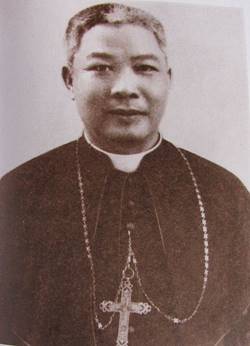
Phêrô Máctinô Ngô Đình Thục (6 tháng 10 năm 1897- 13 tháng 12 năm 1984) là một Giám mục Công giáo Việt Nam.[1] Ông từng giữ chức giám quản Tông Tòa Giáo phận Vĩnh Long và sau khi Toà Thánh thiết lập Hàng giáo phẩm Việt Nam năm 1960, ông trở thành Tổng giám mục Tổng Giáo phận Huế. Ông là anh của tổng thống Ngô Đình Diệm và cố vấn Ngô Đình Nhu, giữ vai trò quan trọng trong chính quyền Việt Nam Cộng Hòa thời Đệ Nhất Cộng Hòa.
Thân thế
Gia đình
Ngô Đình Thục sinh ngày 6 tháng 10 năm 1897 tại Phủ Cam, Huế trong một gia đình vọng tộc. Ông là con thứ thứ ba trong số chín người con của Micae Ngô Đình Khả (nguyên quán làng Đại Phong, huyện Lệ Thủy, tỉnh Quảng Bình) - một quan đại thần của triều Nguyễn, thời vua Thành Thái và Duy Tân.[2] Gia đình Ngô Đìnhcủa ông còn có thể kể đến: Ngô Đình Khôi, Diệm (tổng thống Ngô Đình Diệm), Nhu, Cẩn, Luyện (các anh em trai), Ngô Đình Thị Giao, Hiệp, Hoàng (các chị em gái) và Hồng y Phanxicô Xaviê Nguyễn Văn Thuận (con bà Ngô Đình Thị Hiệp). Như những người anh em của mình đều được cha đặt tên bằng chữ Hán theo các đức tính, tên Thục (俶) của ông có ý nghĩa là "Sự chỉnh tề".
Học tập
Năm 1904-1908, Ngô Đình Thục theo học tại trường Pellerin, một trường tư thục do Sư Huynh Dòng La Sanđiều hành. Tháng 9 năm 1909, ông vào Tiểu Chủng viện An Ninh, Quảng Trị và đến tháng 9 năm 1917, được lên tiếp vào Đại Chủng viện Phú Xuân thuộc Giáo phận Huế.[3] Tháng 11 năm 1919, Giám mục Eugène Allys (tên Việt là Lý, 1852-1936) gửi ông đi du học trường Truyền giáo Rôma. Trong quá trình du học Roma, Ngô Đình Thục đỗ các bằng cấp: Tiến sĩ Triết học năm 1922, Tiến sĩ Thần học năm 1926, cử nhân Văn chương và được vào yết kiến Giáo hoàng Piô XInăm 1922. Rồi từ Roma Ông được cử sang Pháp dạy đại học Sorbonne ở Paris.[2]
Hoạt động tôn giáo
Linh mục
Ngày 20 tháng 12 năm 1925, tại Roma, ông được thụ phong linh mục (do Hồng y Van Rossum truyền chức). Sau đó, linh mục Ngô Đình Thục tiếp tục học thêm một năm ở Đại học Appolinaire lấy bằng Tiến sĩ Giáo luật năm 1927. Linh mục Thục sang Pháp học tại Institut Catholique de Paris từ tháng 10 năm 1927 đến tháng 06 năm 1929 và đỗ Cử nhân Văn chương.[2]
Năm 1929, linh mục Ngô Đình Thục quay về Việt Namvà làm giáo sư dòng Thánh Tâm ở Huế. Từ tháng 11 năm 1929 đến tháng 9 năm 1931, Giám mục Alexandre Chabanon (tên Việt là Giáo, 1873-1936) bổ nhiệm ông làm giáo sư Đại Chủng viện Phú Xuân, Huế. Tháng 10 năm 1933, ông làm Giám đốc trường Thiên Hựu (Providence), một trường tư thục Công giáo tại Huế. Năm 1935, ông làm Chủ nhiệm báo Sacerdos Indosinensis.[2]
Giám mục
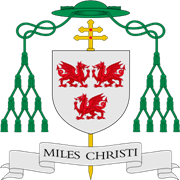
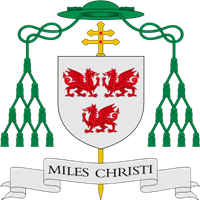
Huy hiệu giám mục của ông có khẩu hiệu tiếng Latinh nghĩa là: Chiến sĩ Chúa Kitô
Ngày 8 tháng 1 năm 1938, Tòa Thánh thành lập tại Việt Nam giáo phận mới là Giáo phận Vĩnh Long, tách từ Giáo phận Sài Gòn, bao gồm địa giới tỉnh Vĩnh Long, Trà Vinh, Bến Tre và 2 quận thuộc tỉnh Cần Thơ. Tòa Thánh bổ nhiệm linh mục Phêrô Máctinô Ngô Đình Thục làm Giám mục giám quản tân giáo phận này (Giám mục Hiệu toà Sæsina).[3] Ngày 4 tháng 5 năm 1938, tại nhà thờ chính tòa Phủ Cam, Khâm sứ Tông tòa Antonin Drapier chủ lễ tấn phong Giám mục Ngô Đình Thục. Đây là vị Giám mục người Việt thứ ba và là Giám quản đầu tiên của Giáo phận Tông Tòa Vĩnh Long.[2]
Ngày 23 tháng 6 năm 1938, Giám mục Ngô Đình Thục chính thức nhận giáo phận với khẩu hiệu "Chiến sĩ Chúa Kitô". Đây là vị Giám mục Giám quản tiên khởi của tân giáo phận Vĩnh Long và có nhiều đóng góp xây dựng giáo phận suốt 23 năm tại nhiệm.[2]
Trên cương vị Giám mục Vĩnh Long, ông đã đặt một kiến trúc tư gia để làm trụ sở Tòa Giám mục, lập Tiểu Chủng viện Á Thánh Minh năm 1944 gồm 3 lớp, khai giảng ngày 15 tháng 8 năm 1944 ban đầu có 15 chủng sinh. Dòng Thầy giảng Cái Nhum được trùng tu và mang tên mới là Dòng Sư Huynh Kitô Vua. Cải tiến Dòng Mến Thánh Giá Cái Mơn và Cái Nhum, các nữ tu được gửi đi học các trường trung học và đại học. Tổ chức khoá huấn luyện thanh niên, hoạt động Công giáo Tiến hành.[2]
Tổng Giám mục
Năm 1960, Công giáo tại Việt Nam được Tòa Thánh thiết lập Hàng giáo phẩm chính tòa với ba Tổng giáo phận: Hà Nội, Huế, Sài Gòn. Giám mục Ngô Đình Thục được thăng chức tổng Giám mục và về nhận sứ vụ tại Tổng giáo phận Huếvào ngày 12 tháng 4 năm 1961. Đây là lần đầu tiên một người Việt Nam làm Tổng giám mục chính tòa cai quản một Tổng giáo phận. Giáo phận Vĩnh Long được trao lại cho do tân Giám mục Antôn Nguyễn Văn Thiện cai quản.[2]
Khi đương nhiệm Tổng Giám mục Huế, Giám mục Ngô Đình Thục đã kiến tạo hoàn toàn Nhà thờ chính tòa Phủ Cam. Nhà thờ cổ kính này được xây cất từ 1898 nên xuống cấp trầm trọng, Giám mục Thục cho phá hủy và xây mới theo đồ án thiết kế của kiến trúc sư Ngô Viết Thụ. Cũng trong thời gian từ năm 1962-1963, Giám mục Ngô Đình Thục đã thực hiện cho tổng giáo phận này nhiều công trình:[2]
- Trùng tu Tòa Giám mục và Nhà Chung.[2]
- Sửa sang Đại Chủng viện Phú Xuân Huế, mời các linh mục giáo sư thuộc Hội Xuân Bích (Sulpice) về giảng dạy.[2]
- Thành lập Tiểu Chủng viện Hoan-Thiện (lấy tên hai vị thánh Tử đạo Đoàn Trinh Hoan và Trần Văn Thiện). Sau đó tiến hành Thành lập Liên chủng viện cho toàn tổng giáo phận Huế.[2]
- Năm 1962, thống nhất các dòng Mến Thánh Giá trong tổng giáo phận: Di Loan (dời vào La Vang), Tam Toà (dời vào Kim Long), Kẻ Bàng (sát nhập vào Phủ Cam), Phủ Cam, Dương Sơn, Trí Bưu. Sáu nhà dòng này tạo thành Dòng Mến Thánh Giá Thừa sai Huế, nay là Dòng Mến Thánh Giá Huế.[2]
- Đặc biệt, ông tiến hành trùng tu và tôn tạo khu vực La Vang trở thành trung tâm hành hương của giáo dân Việt Nam. Xin Tòa Thánh nâng nhà thờ La Vang lên bậc Vương cung thánh đường. Lập tờ Nguyệt san Đức Mẹ La Vang, thu hút đông đảo người đọc và người viết cộng tác.[2]
Hoạt động xã hội
Giám mục Thục còn tham gia các hoạt động xã hội như: xây dựng 6 trường Trung học tư thục, nhận học sinh Công giáo và cả học sinh không Công giáo. Xây cất dưỡng đường Á Thánh Minh ở Vĩnh Long và dưỡng đường thánh Phêrô ở Sài Gòn. Xây nhà Xã hội tại thị xã Vĩnh Long làm nhà đọc sách, diễn thuyết, sinh hoạt cho nhân dân. Trùng tu nhiều cô nhi viện của giáo phận.[2]
Gây ảnh hưởng chính trị
Đã có thời, tòa Giám mục Vĩnh Long là nơi tấp nập người qua kẻ lại nhiều lần. Việc Giám mục Thục dính dáng vào việc kinh tế tài chính khá ầm ĩ, dù có rằng tài chính ấy cũng góp vào việc lo từ thiện xã hội và kiến thiết giáo hội. Việc tổ chức lễ hội trong giáo phận cũng tác động nhiều đến thái độ bất bình của nhiều thành phần vốn không ưa thích Công giáo, vì coi Công giáo như đạo Tây phương, "ngoại lai" theo kiểu tinh thần cấm đạo thời Nhà Nguyễn và Văn Thân.
Khi em trai là Ngô Đình Diệm bị Pháp kết án, trong thư gửi Toàn quyền Đông Dương, ông Thục kêu gọi Pháp ân xá cho em mình[4]:
Nếu hoạt động của hai em tôi được chứng tỏ là có hại cho quyền lợi nước Pháp thì – với tư cách của một Giám mục, của một người An-nam, và với tư cách là người con của một gia đình mà thân phụ tôi đã phục vụ nước Pháp ngay từ khi Pháp mới đến An-nam, và đã nhiều lần đưa mạng sống cho nước Pháp trong các cuộc hành quân mà cha tôi cầm đầu, dưới quyền Nguyễn Thân, chống lại các kẻ nổi loạn do Phan Đình Phùng chỉ huy, tại Nghệ An và Hà Tĩnh – tôi, tự đáy lòng, không chấp nhận
...Có thể tôi lầm, tuy nhiên, thưa Đô Đốc, tôi xin thú thực là không tin – cho đến khi được chứng minh ngược lại – rằng các em tôi đã phản lại truyền thống của gia đình chúng tôi đến như thế, một gia đình đã tự mình gắn liền với nước Pháp từ lúc ban đầu, trong khi ông cha của những quan lại bây giờ hầu hết đều chống lại Pháp và chỉ quyết định thiên về Pháp khi thấy có lợi... Tôi nêu ra điều nầy khi xét thấy rằng thân phụ tôi là Ngô Đình Khả đã từng được vinh dự phục vụ nước Pháp dù sinh mạng bị hiểm nguy, và khi xét đến quá trình lâu dài của các em tôi, một quá trình được hình thành bằng lòng tận tụy vô bờ của các em tôi đối với nước Pháp, mà không sợ phải hy sinh mạng sống của mình cho nước Pháp.
Năm 1945, Giám mục Thục được mời ra Phát Diệm dự lễ tấn phong Giám mục Tađêô Lê Hữu Từ, nhưng bị kẹt tại Biên Hòa nên phải trở lại Vĩnh Long. Trong thời kỳ rối ren ở Việt Nam những năm 1940, có nguồn tin cho rằng, Giám mục Thục đã tích cực vận động người Nhật bảo vệ cho ông Ngô Đình Diệm, do sợ chính phủ Pháp bắt giam ông Diệm vì ông có tinh thần chống Pháp. Nhật đáp lại bằng việc nhiều lần mời ông Diệm đứng ra lập chính phủ nhưng ông Diệm từ chối, vì ông nghĩ rằng chính phủ do Nhật hậu thuẫn sẽ không có khả năng tồn tại lâu bền tại Việt Nam thời bấy giờ.
Trong một dịp, Giám mục Ngô Đình Thục có cơ hội tiếp xúc với Hồng y Francis Spellman Giáo phận New York, kiêm Tuyên úy quân lực Hoa Kỳ tại Sài Gòn. Ngày 18 tháng 6 năm 1950, cùng với ông Diệm và ông Nguyễn Viết Cảnh, ông sang Hoa Kỳ và đến Rôma tham dự Năm Thánh. Ngày 14 tháng 8 năm 1950, hai anh em nhà Ngô rời Sài Gòn để sang Nhật gặp Cường Ðể bàn việc lập chính phủ. Như vậy, chính phủ của ông Ngô Đình Diệm đã được thành lập và đi vào hoạt động trên phần lãnh thổ Quốc gia Việt Nam và sau này hậu thân là Việt Nam Cộng hòa.
Sự kiện Phật Đản, 1963 bùng nổ ở miền Nam Việt Nam - nhất là ở Huế, khi chính phủ Tổng thống Ngô Đình Diệm cấm treo cờ Phật giáo bên ngoài khuôn viên cơ sở Phật giáo làm Giám mục Thục lâm vào tình thế khó khăn để ứng phó.
Trước dư luận của nhiều người, nhất là người ngoài Công giáo, Giám mục Thục là người có tham vọng nhiều hơn so với các anh em trong Ngô gia, lúc thì ông tìm kiếm sự hỗ trợ của Tòa Thánh, lúc thì của Hoa Kỳ dành cho ông Diệm. Khi ông Diệm nắm chính quyền, theo tinh thần Công giáo, ông đã muốn nhân cơ hội này tích cực truyền bá đức tin Công giáo cho quần chúng Việt Nam. Việc ông làm Tổng Giám mục Huế cũng gây ra những đàm tiếu, chỉ trích và ác cảm vì vùng đất Huế vốn là nơi có nhiều người sùng tín Phật giáo.
Năm 1963, cả bộ máy chính quyền Việt Nam Cộng hòa được cho rằng ráo riét tổ chức kỉ niệm 25 năm giám mục cho ông. Linh mục Trần Tam Tỉnh đã thuật lại việc tổ chức mừng lễ này như sau trong quyển biên khảo Thập giá và lưỡi gươm (Nhà xuất bản Sud- Est Asie, Paris, 1978): “Từ tháng ba, một ủy ban ngân khánh đã được thành lập do chủ tịch quốc hội là chủ tịch với nhiều vị bộ trưởng và nhân vật tên tuổi làm ủy viên. Người ta tổ chức tại Sài Gòn một bữa tiệc mà mỗi thực khách phải đóng 5.000 đồng (tương đương nửa lượng vàng thời điểm đó, chú thích của TTCN). Người ta muốn biến lễ ngân khánh này thành quốc lễ” (tr.135).[5]
Từ vị trí anh của tổng thống, Thục đã đồng hóa vai trò lãnh đạo tôn giáo của mình với lãnh đạo đất nước. Linh mục Trần Tam Tỉnh viết:[5] “Vị giám mục này (Ngô Đình Thục), anh của tổng thống, đã hóa thành trí não tuyệt vời của chế độ. Người ta tìm đến ông để xin xỏ ân huệ, đặc quyền. Giám mục làm như là hiện thân của giáo hội, cũng như ông em là hiện thân của Nhà nước. Đáp lại các lời chỉ trích, giám mục Thục nói với ICI, một tạp chí Công giáo số 15-4-1963, rằng “Trên bàn giấy của tôi chồng chất cả lô đơn xin tôi can thiệp cho họ ơn này, ơn nọ, khổ thay thường chỉ là thế tục. Tôi không thể dửng dưng được trước lời kêu gọi của họ! Ở vào địa vị của tôi các ông sẽ xử sự như thế nào?”. Suốt tám năm trước đó, Diệm - Nhu và nhà Ngô đã ung dung cai trị miền Nam theo cách của mình với thuyết nhân vị, không thấy Washington phản ứng! Ấy vậy mà nay Washington lại bảo ngưng thuyết nhân vị là vì sao?
Khủng hoảng tôn giáo
Bối cảnh
Năm 1961, nhận chức Tổng giáo mục Huế. Năm 1962, ông cùng các Giám mục người Việt khác được mời sang tham dự Công đồng Vatican II. Mùa hè năm 1963, quay về Việt Nam, cùng thời gian này thì miền nam Việt Nam xảy ra Sự kiện Phật Đản, 1963. Mùa thu năm ấy, ông lại sang Rôma dự Công đồng Vatican II thì ở miền Nam Việt Nam xảy ra đảo chính lật đổ Diệm-Nhu.[2] Khi Công đồng bế mạc, ông không thể về lại Việt Nam được nữa. Giám mục Philípphê Nguyễn Kim Điền được Tòa Thánh bổ nhiệm làm Tổng Giám mục Huế thay ông.
Tác nhân
Trong một chừng mực nào đó, Giám mục Ngô Đình Thục gặp nhiều thuận lợi trong thời Ngô Đình Diệm còn làm tổng thống Việt Nam Cộng hòa. Đến cuối năm 1963, Ngô Đình Diệm và ông cố vấn Ngô Đình Nhu bị lật đổ cùng với nền Đệ Nhất Cộng hòa Việt Nam, Giám mục Thục phải sống lưu vong ở hải ngoại và ông bị lâm vào tình trạng khủng hoảng niềm tin (với chính quyền mới) và đức tin (với Giáo hội Công giáo).[2] Nhiều nhận định cho rằng, sự khủng hoảng của ông cao độ như vậy là do ông đã dấn thân quá nhiều vào quyền lực xã hội.
Biểu hiện
Sau cuộc đảo chính tháng 11 năm 1963 với cái chết của các em ruột, Giám mục Thục sống lưu vong ở ngoại quốc. Ông được Tòa Thánh chỉ định Tổng Giám mục hiệu tòa Bulla Regia từ năm 1968.
Đương lúc tại Công đồng Vatican II, Giám mục Thục đã bắt đầu bộc lộ nhiều lập trường khác lạ và đi quá xa với truyền thống giáo huấn của Giáo hội Công giáo Rôma. Ông cũng đã lớn tiếng than phiền giáo hội không mời nhiều lãnh đạo tôn giáo khác tham dự Công đồng, mà theo ông là đáng lẽ nên mời. Sau này, ông đã được biết là họ đã được Công đồng mời.
Tấn phong Giám mục bất hợp thức
Những cải tổ Giáo hội theo Công Đồng Vatican II đã đưa đến sự chống đối của những Giám mục phái "bảo thủ", như Giám mục Lefèvre thuộc dòng Phanxicô ở Rochester New York, chống lại Giáo hội Công giáo từ thời Giáo hoàng Phaolô VI, bị Tòa thánh phạt "vạ tuyệt thông", Lefèvre đã ly khai Giáo hội La Mã. Giám mục Ngô Đình Thục đã theo Giám mục Lefèvre từ năm 1976, lập phong trào "Giáo hội La Mã Chính thống" (Orthodox Roman catholic movement, gọi tắt là ORCM) qui tụ Giám mục ly khai Lefèvre và các Giám mục được ông phong chức bất hợp pháp. Tổng giám mục Thục và nhóm ORCM chống Tòa thánh Roma mãnh liệt, Tòa thánh phải ra "vạ tuyệt thông" nhiều lần.[2]
Ngày 1 tháng 1 năm 1976, Giám mục Thục tự tấn phong cho Dominguez Gomez và bốn người khác thuộc nhóm li giáo ở Palmar de Troya (Tây Ban Nha) làm Giám mục mà không có chuẩn y của Giáo hoàng cũng như không có đầy đủ các thủ tục cần thiết trước đó. Tòa thánh lập tức rút phép thông công ông và những người tham gia vào các cuộc tấn phong bất hợp thức trên. Vào tháng 5 và tháng 10 năm 1981, ông tiếp tục tự ý tấn phong Giám mục cho ba người nữa. Một số nguồn cho rằng ngoài ra ông còn tấn phong Giám mục bất hợp thức một vài lần khác nữa.
Như thế, ngoài các Giám mục hợp thức tại Việt Nam mà ông đã tấn phong theo sự chuẩn nhận của Tòa thánh, Giám mục Thục là người tấn phong chính (chủ phong) bất hợp thức cho ít nhất 8 người: năm người trong nhóm Palmariana và ba người theo "thuyết trống ngôi" (sedevacantism), ông cũng đã tấn phong có điều kiện (sub conditione - giả thiết các lần tấn phong trước không thành sự) cho ba giáo sĩ khác. Các Giám mục do Giám mục Thục tấn phong kể trên lại đi tấn phong cho những người khác làm Giám mục.
Trong suốt thời gian khủng hoảng, ông đã nhiều lần hối lỗi, được tha vạ tuyệt thông rồi lại tiếp tục tái phạm và bị dứt phép thông công. Cuối cùng, ông đã quay trở lại với giáo hội và qua đời trong tình trạng hiệp thông với giáo hội.
Qua đời
Sau khi được giải vạ vào năm 1984, Giám mục Ngô Đình Thục được chủ tọa Đại hội Thánh Mẫu ở Carthage vào tháng 8 cùng năm. Khi đó, ông phát biểu những lời này, được cho là những lời cuối đời của ông trước công chúng:[2] "Từ 20 năm, tôi chưa hề thấy người Việt đông như thế này. Nay Mẹ đưa tôi về đây gặp anh chị em lần sau hết. Xin phú thác anh chị em và cũng là đại diện cho dân Việt Nam trong Thánh Tâm Mẹ. Xin mọi người cầu nguyện cho tôi được chết lành".
Đến ngày 5 tháng 12 năm 1984, tổng Giám mục Thục trở bệnh nặng và được đưa đến bệnh viện St John, Joplin. Ông qua đời vào đêm 13 tháng 12 năm 1984, tại Carthage, hưởng thọ 87 tuổi, 46 năm làm Giám mục và được an táng tại nghĩa trang Resurrection Cemetary, Springfield, Missouri Orléans, Hoa Kỳ.[2]
Chú thích
- ^ Ðức cố Tổng Giám mục Phêrô Martinô Ngô Ðình Thục Nguyên Tổng Giám mục Tổng Giáo phận Huế
- ^ a ă â b c d đ e ê g h i k l m n o ô ơ p “Tiểu sử Giám mục Phêrô Mactinô NGÔ ĐÌNH THỤC GIÁM MỤC TIÊN KHỞI GIÁO PHẬN VĨNH LONG”. GP. Vĩnh Long. Truy cập Ngày 22 tháng 4 năm 2016.
- ^ a ă Tổng Giám mục Ngô Đình Thục (1897–1984): Thần quyền với Thế quyền
- ^ Tuyển Tập "1963-2013 Năm Mươi Năm Nhìn Lại" (2013), Vũ Ngự Chiêu, trang 94
- ^ a ă “Mỹ - Diệm - cuộc đảo chính Diệm Nhu: Tổng giám mục Ngô Đình Thục”. Việt Báo.
Tham khảo
- https://www.dunglac.org/index.php?m=module2&v=detailarticle&id=55&ia=5232
- https://www.giaophanvinhlong.net/Giaophan/giammuc.htm
Liên kết ngoài
- Roman Catholic Hierarchy: Archbishop Ngô dinh Thuc
- "Misericordias Domini in æternum cantabo": Autobiography by Mgr. Ngô Dinh Thuc, written ca. 1978-1980. Published in: Einsicht - röm.-kath. Zeitschrift
- In Memoriam Monseigneur Peter Martin Ngo-Dinh-Thuc by Most Rev. M.L. Guerard des Lauriers, O.P.
- Sedevacantist Declaration of Archbishop Thuc
- PDF Document of Einsicht, 1982 - Includes Photographic Documentation of most of Archbishop Thuc's consecrations
- A critical evaluation of the validity of the episcopal consecrations conferred by Archbishop Ngo Dinh Thuc, according to Roman Catholic standards.
- "Archbishop Thuc: a brief defense by sedevacantist bishop Daniel Dolan.
-----------------
1. https://alchetron.com/Ngo-Dinh-Thuc-1311419-W
Ngo Dinh Thuc
See Archdiocese of Hue - - Installed 24 November 1960 - Term ended 17 February 1968 - Name Ngo Thuc
Predecessor Jean-Baptiste Urrutia as Vicar Apostolic of Hue
Successor Philippe Nguyen-Kim-Dien
Other posts Vicar Apostolic of Vinh Long, Vietnam (8 January 1938–24 November 1960) Titular Bishop of Saesina (8 January 1938–24 November 1960) Titular Archbishop of Bulla Regia (17 February 1968–13 December 1984)
Ngo dinh thuc exposed archbishop thuc bishops and consecrations facts history and consequences
Sponsored Links
Pierre Martin Ngo Dinh Thuc ([ŋo din tʰukp]) (6 October 1897 – 13 December 1984) was the Roman Catholic Archbishop of Hue, Vietnam and a member of the Ngo family, who ruled South Vietnam in the years leading up to the Vietnam War. He was the founder of Dalat University.
In 1963, while in Rome attending the second session of the Second Vatican Council, his younger brother Diem, who was president of South Vietnam, was assassinated in a military coup. Thuc was unable to return to Vietnam and lived the rest of his life in exile, living in Rome, France and the United States. During this time, he became involved with the Traditionalist Catholic movement and consecrated a number of bishops without the Vatican's approval for the Palmarian and Sedevacantist movements. As a result, he was excommunicated by and reconciled with Rome a number of times.
Family
Ngo Dinh Thuc was born in Hue to an affluent Roman Catholic family as the second of six sons born to Ngo Dinh Kha, a mandarin of the Nguyen dynasty who served Emperor Thanh Thai during the French occupation of Vietnam.
Thuc's elder brother, Khoi, served as a governor. Khoi was reportedly buried alive by the Viet Minh right after the August Revolution in August 1945 for having been a mandarin of the French-controlled Emperor Bao Dai's administration. Three other brothers, Diem, Nhu and Can, were all politically active. Diem had been Interior Minister under Bao Dai in the 1930s for a brief period, and sought power in the late 1940s and 1950s under a Catholic anti-communist platform as various groups tried to establish their rule over Vietnam. Diem led a coup, overthrowing the emperor and becoming president of South Vietnam in 1955. Diem, Nhu and Can were all later assassinated during the 1963 South Vietnamese coup.
Cardinal Francois Xavier Nguyen Van Thuan (1928–2002) was Thuc's nephew.
Career in Vietnam
At age twelve, Thuc entered the minor seminary in An Ninh. He spent eight years there before going on to study philosophy at the major seminary in Hue. Following his ordination as a priest on 20 December 1925, he taught at the Sorbonne. He was selected to study theology in Rome, Italy, and returned to Vietnam in 1927 after having been awarded three doctorates from the Pontifical Gregorian University in Rome in philosophy, theology, and Canon law. He then became a professor at the College of Vietnamese Brothers in Hue, a professor at the major seminary in Hue, and Dean of the College of Providence. In 1938, he was chosen by Rome to direct the Apostolic Vicariate at Vinh Long. He was consecrated a bishop on 4 May 1938, being the third Vietnamese priest raised to the rank of bishop.
In 1950 Diem and Thuc applied for permission to travel to Rome for the Holy Year celebrations at the Vatican but went instead to Japan to lobby Prince Cuong De to enlist support to seize power. They met Wesley Fishel, an American academic consultant for the U.S. government. Fishel was a proponent of the anti-colonial, anti-communist third force doctrine in Asia and was impressed by Diem. He helped the brothers organise contacts and meetings in the United States to enlist support.
With the outbreak of the Korean War and McCarthyism in the early 1950s, Vietnamese anti-communists were a sought-after commodity in the United States. Diem and Thuc were given a reception at the State Department with the Acting Secretary of State James Webb, where Thuc did much of the talking. Diem also made links with Cardinal Francis Spellman, the most politically influential cleric of his time. Spellman had studied with Thuc in Rome in the 1930s and became one of Diem's most powerful advocates. Diem managed an audience with Pope Pius XII in Rome with his brother's help. Spellman helped Diem to garner support among right-wing and Catholic circles. As French power in Vietnam declined, Diem’s support in America, which Thuc helped to nurture, made his stock rise. Bao Dai made Diem the Prime Minister of the State of Vietnam because he thought Diem's connections would secure funding.
Diem's rule
In October 1955, Diem deposed Bao Dai in a fraudulent referendum organised by Nhu and declared himself President of the newly proclaimed Republic of Vietnam, which then concentrated power in the Ngo family, dedicated Roman Catholics in a Buddhist majority country. Power was enforced through secret police and the imprisonment and torture of political and religious opponents. The Ngos' policies and conduct inflamed religious tensions. The government was biased towards Catholics in public service and military promotions, as well as the allocation of land, business favors and tax concessions.
On 24 November 1960, Thuc was named Archbishop of Hue by Pope John XXIII making him the most senior Catholic official in the country. Thuc used his position to seize farms, businesses, urban real estate, rental property and rubber plantations for the Catholic Church and to enrich his immediate family. He used Army of the Republic of Vietnam personnel to work on his timber and construction projects. He sought “voluntary donations” from businessmen using paperwork that resembled tax notices. The 370,000 acres (1,500 km²) of Catholic Church land in the country were exempted from land reform, whereas other holdings larger than 1.15 km² were split up and given away.
Diem once told a high-ranking officer, forgetting that he was a Buddhist, “Put your Catholic officers in sensitive places. They can be trusted.” Many officers in the Army of the Republic of Vietnam converted to Catholicism in the belief that their military prospects depended on it. Additionally, the distribution of firearms to village self-defense militias intended to repel Viet Cong guerrillas saw weapons given only to Catholics. Some Catholic priests ran their own private armies, and in some areas forced conversions, looting, shelling and demolition of pagodas occurred.
Some Buddhist villages converted en masse in order to receive aid or avoid being forcibly resettled by Diem’s regime. The Catholic Church was the largest landowner in the country, and the “private” status that was imposed on Buddhism by the French, which required official permission to conduct public Buddhist activities, was not repealed. Catholics were also de facto exempt from the corvee labor that the government obliged all citizens to perform; U.S. aid was disproportionately distributed to Catholic majority villages. Under Diem, the Catholic Church enjoyed special exemptions in property acquisition; and, in 1959, Diem dedicated his country to the Virgin Mary.
The white and gold Vatican flag was regularly flown at all major public events in South Vietnam. U.S. Aid supplies tended to go to Catholics, and the newly constructed Hue and Da Lat universities were placed under Catholic authority to foster a Catholic academic environment. The government erected banners reading “Long Live the Catholic Church” in French, Latin, and Vietnamese, and gave state receptions with full military honors to Catholic dignitaries, such as Archbishop of New York Francis Cardinal Spellman. During one visit, Spellman announced that he would donate US$50,000 to South Vietnam, explicitly stating that only Catholics would receive aid.
Buddhist unrest and downfall of Diem
In May 1963, in the central city of Hue, where Thuc was archbishop, Buddhists were prohibited from displaying the Buddhist flag during Vesak celebrations commemorating the birth of Gautama Buddha, when the government cited a regulation prohibiting the display of non-government flags at Thuc's request. A few days earlier, Catholics were encouraged to fly Vatican flags to celebrate Thuc's 25th anniversary as bishop. Government funds were used to pay for Thuc's anniversary celebrations, and the residents of Hue—a Buddhist stronghold—were also forced to contribute. These double standards led to a Buddhist protest against the government, which was ended when nine civilians were shot dead or run over when the military attacked. Despite footage showing otherwise, the Ngos blamed the Viet Cong for the deaths, and protests for equality broke out across the country. Thuc called for his brothers to forcefully suppress the protesters. Later, the Ngos' forces attacked and vandalised Buddhist pagodas across the country in an attempt to crush the burgeoning movement. It is estimated that up to 400 people were killed or disappeared.
Diem was overthrown and assassinated together with Nhu on 2 November 1963. Ngo Dinh Can was sentenced to death and executed in 1964. Of the six brothers, only Thuc and Luyen survived the political upheavals in Vietnam. Luyen was serving as ambassador in London, and Thuc had been summoned to Rome for the Second Vatican Council. After the Council (1962–65), for political reasons and, later on, to evade punishment by the post-Diem government, Archbishop Thuc was not allowed to return to his duties at home and thus began his life in exile, initially in Rome.
Exile
Thuc moved to Toulon, France, where he was assigned a confessional in the cathedral until about 1981. He at least once concelebrated the Mass of Paul VI (the new rite of Mass promulgated by Pope Paul VI in 1969) in the vernacular. One author claims Thuc served at the Mass of Paul VI as an acolyte several times.
Convinced of a crisis devastating the Roman Catholic Church and coming under the increasing influence of sedevacantist activists, Thuc consecrated several bishops without a mandate from the Holy See. In December 1975 he went to Palmar de Troya, where he ordained Clemente Dominguez y Gomez—who claimed to have witnessed an apparition of the Blessed Virgin Mary—and others, and the following month he consecrated Dominguez and four followers as bishops. In May 1981 Thuc consecrated a French priest, Michel-Louis Guerard des Lauriers, as bishop. Des Lauriers was a Dominican, an expert on the dogma of the Assumption and advisor to Pope Pius XII, and former professor at the Pontifical Lateran University. In October 1981, he consecrated two Mexican priests and former seminary professors, Moises Carmona (of Acapulco) and Adolfo Zamora (of Mexico City). Both of these priests were convinced that the Papal See of Rome was vacant and the successors of Pope Pius XII were heretical usurpers of papal office and power. In February 1982, in Munich's Sankt Michael church, Thuc issued a declaration that the Holy See in Rome was vacant, intimating that he desired a restoration of the hierarchy to end the vacancy. However, his newly consecrated bishops became a fragmented group. Many limited themselves essentially to sacramental ministry and only consecrated a few other bishops.
Thuc may have performed other consecrations besides the five bishops at Palmar de Troya and the three sedevacantists in 1981. There are claims that he consecrated two priests, Luigi Boni and Jean Gerard Roux, in Loano in Italy on 18 April 1982, but a Dr. Heller, of Una Voce in Munich, has said that Thuc was with him in Munich on that date. The bishops consecrated by Thuc proceeded to consecrate other bishops for various Catholic splinter groups, many of them sedevacantists. Thuc departed for the United States at the invitation of Bishop Louis Vezelis, a Franciscan former missionary priest who had agreed to receive Episcopal Consecration by the Thuc line Bishop George J. Musey, assisted by co-consecrators, Bishops Carmona, Zamora and Martinez, in order to provide bishops for an "imperfect council" which was to take place later in Mexico in order to elect a legitimate Pope from among themselves.
Thuc died at the monastery of the Vietnamese American religious Congregation of the Mother Co-Redemptrix on 13 December 1984, at Carthage, Missouri, aged 87.
References
1. https://bishopjosephmarie.org/doctrine/invalidorders.html
Traditional Catholics - Do Your Clergy Possess Valid Orders?
II. THE CASE AGAINST BISHOP THUC
The Validity of the Thuc Lineage
Those tracing their ordinations and/or consecrations back to Bishop Thuc are legion, and in virtue of their sheer numbers alone, are drowning out the voices of those who legitimately call into question a very weighty issue with eternal consequences attached to it: were the consecrations performed by Archbishop Thuc valid?
Much of what I present below is an attempt to counter-balance the factual misinformation which seems prevalent everywhere regarding Bishop Thuc. On the part of some, there has been a considerable amount of “white-washing” of the not-so-edifying history of Bishop Thuc, with the result that many people have formed opinions on him based on factual errors and omissions.
The victim of all this, besides truth itself, are all those well-meaning Catholics who have misplaced their trust in the validity of the Sacramental Orders emanating from him. I believe that this needs to be corrected.
1. BRIEF HISTORY OF BISHOP THUC
Unlike Marcel Lefebvre, there is no reason to doubt the personal validity of Bishop Pierre Martin Ngo Dinh Thuc’s consecration. He was a valid bishop with the power to validly consecrate other bishops. But like Lefebvre’s consecrator, Cardinal Liénart, the question of a valid sacramental intention causes concern in his regard too. His advocates would have us blindly accept the validity of his consecrations and ignore that which is externally manifest, i.e., Bishop Thuc was, by and large, not a traditionalist; his behavior was very erratic; and he said and did many things which cast serious doubts upon the validity of the consecrations performed by him. First, a brief look at the historical Bishop Thuc.
Born in 1897, Bishop Ngo Dinh Thuc was consecrated a bishop in South Vietnam in 1938, and promoted to the dignity of “archbishop” in 1960 by the false pope – John XXIII.
Bishop Thuc was an active participant in Vatican Council II and reportedly signed all of the documents of that false council. After the close of Vatican Council II, Paul VI would not permit him to return to Vietnam, so Bishop Thuc started his life as a disgruntled exile in Rome. In 1968, Paul VI appointed Bishop Thuc as Titular Archbishop of Bulla Regia (an ancient, now vacant see in Tunisia).
The Consecration Spree Starts
While living in Rome, Bishop Thuc got to know Fr. Ravaz, who at the time was teaching in Marcel Lefebvre's seminary in Switzerland. In the mid-1970’s, Fr. Ravaz became involved with a group of “visionaries” in Palmar de Troya, Spain, headed by an insurance broker, Clemente Dominguez Gomez, who believed that the "real" Paul VI was a prisoner of the Vatican and that the visible Paul VI was a living duplicate of the imprisoned one. (After Paul VI died in 1978, Dominguez claimed that Christ had mystically crowned him pope and he took the name of Gregory XVII. He subsequently started his own church and declared Paul VI to be a martyr-saint.)
One day Fr. Ravaz told Bishop Thuc that “Our Lady” had work for him to do in Palmar de Troya, and so off went Bishop Thuc. On December 31, 1975, Bishop Thuc ordained Clemente and four other lay men to the priesthood, and just 12 days later he consecrated two of the five newly ordained men and three others to the episcopacy for the Palmar de Troya group. (As an aside, in less than 2 years Clemente "consecrated" to the episcopacy no less than 70 men.)
Because Bishop Thuc did this without a mandate (permission) from Rome, on September 17, 1976, Paul VI “excommunicated” him. Thereupon Bishop Thuc quickly repented, renounced what he had done in Spain, and Paul VI received him back into the Vatican II church.
On July 10, 1977, just six months after the Palmarian consecrations, we find Thuc consecrating his first bishop for the Old Catholic Church, Labat d'Arnoux. On February 2, 1977, Bishop Thuc conditionally consecrated another Old Catholic by the name of Jean Laborie (who, incidentally, had been previously consecrated four other times.) Over the next few years, Bishop Thuc will consecrate at least three more bishops for the Old Catholic Church.14
In 1978, Bishop Thuc moved to Toulon, France and took up residence with a Buddhist Vietnamese family. While there, he regularly assisted Vatican II bishop, Barthe de Frejus, at his Cathedral in Toulon.
On April 16th, 1981, Holy Thursday, Bishop Thuc was caught concelebrating the New Mass with Barthe de Frejus. He had also been hearing “confessions” of the Vatican II church members in the same cathedral. Yet a mere three weeks after this event, Bishop Thuc had his first flirt with traditional Catholicism and consecrated Guerard des Lauriers on May 7, 1981.
Then on October 17, 1981, Bishop Thuc consecrated two traditionalists Mexican priests, Moises Carmona and Aldolfo Zamora.
On April 18, 1982, and then again on September 25, 1982, Bishop Thuc consecrated two more traditionalist bishops, Luigi Boni and Christian Datessen respectively.
Later in 1982, Bishop Thuc moved to New York to live with a traditionalist bishop of Thuc lineage – Louis Vezelis.
On March 12, 1983, John Paul II excommunicated Bishop Thuc for once again consecrating without a mandate from Rome.
On January 8, 1984, Bishop Thuc moved to Carthage Missouri to live at a Vatican II Vietmenese seminary located there, and it is there that he died on December 13, 1984.
So in the course of six years, Bishop Thuc consecrated 15 men: 5 for the Palmarian Church, 5 for the Old Catholic Church, and 5 for various traditional Catholic Churches.15Considering that the average bishop performs 1 consecration in the course of his life, 15 or more consecrations in the span of six years is quite extraordinary, to say the least. Was all of this done in an effort by Bishop Thuc to preserve traditional Catholicism, as some claim? The answer to this question can be clarified by examining the conduct of Bishop Thuc himself, being cognizant of the fact that a man’s actions do indeed, speak louder than his words.
2. BISHOP THUC – THE “TRADITIONALIST”
The fact that Bishop Thuc, at least at certain times in his life, embraced some traditional practices is beyond dispute. Here is some of the evidence to support it:
* Father Noel Barbara, a traditionalist priest, accompanied by Father Barthe, met with Bishop Thuc on two occasions, once in March, 1981 and again in January, 1982. He wrote of his visits:
“Archbishop Thuc informed us that he celebrated Mass in his apartment early every morning, and always in the traditional rite… In the corner [Thuc’s apartment] was a table on which he celebrated the traditional rite as codified by Saint Pius V every morning.” 16
* In 1988, several “traditionalist priests” flew to Germany to interview Drs. Hiller and Heller, two traditional Catholic Germans who produce a publication called Einsicht. Drs. Hiller and Heller, friends and advocates of Bishop Thuc, had personally known the then deceased Bishop and had been active participants in several of the Thuc consecrations. These interviews with Drs. Hiller and Heller were recorded and excerpts of them put into print:
“Hiller said of Thuc: He said to himself, ‘I have nothing to lose. There is only one thing to continue the Catholic Church… When I ordain priests or consecrate bishops, perhaps, the Catholic Church will have a chance to continue.’” 17 [It is outside of the scope of this article to address this and the other theological errors expressed by Bishop Thuc.]
* The above named Einsicht published Bishop Thuc’s autobiography, reportedly written between 1978 and 1980. In this unauthenticated biography Bishop Thuc wrote:
“Vatican II seems to have the same goal as Communism: temporal human bliss. The following scandal therefore occurred: Prohibition of the least attack against Communism. Therefore the dogma: ‘the natural goodness of all types of beliefs.’”
* In February, 1982, a declaration of Bishop Thuc was published. We will take a closer look at this Declaration shortly, but here is the English translation, presented in its entirety:
"Declaration of Bishop Peter Martin Ngo Dihn Thuc How does the Catholic Church appear today as we look at it? In Rome, John Paul II reigns as "Pope," surrounded by the body of Cardinals and of many bishops and prelates. Outside of Rome, the Catholic Church seems to be flourishing, along with its bishops and priests. The number of Catholics is great. Daily the Mass is celebrated in so many churches, and on Sundays the churches are full of many faithful who come to hear the Mass and receive Holy Communion. But in the sight of God, how does today's Church appear? Are the Masses both the daily ones and those at which people assist on Sundays pleasing to God? By no means, because that Mass is the same for Catholics as it is for Protestants therefore it is displeasing to God and invalid. The only Mass that pleases God is the Mass of St. Pius V, which is offered by few priests and bishops, among whom I count myself. Therefore, to the extent that I can, I will open seminaries for educating candidates for that priesthood which is pleasing to God. Besides this "Mass," which does not please God, there are many other things that God rejects: for example, changes in the ordination of priests, the consecration of bishops, and in the Sacraments of Confirmation and of Extreme Unction.
Moreover, the "priests" now hold to:
- modernism;
- false ecumenism;
- the adoration [or cult] of man;
- the freedom to embrace any religion whatsoever;
- the unwillingness to condemn heresies and to expel the heretics.
Therefore, in so far as I am a bishop of the Roman Catholic Church, I judge that the See of the Catholic Church in Rome to be vacant; and it is necessary for me, as bishop, to do all that is needed so that the Catholic Church in Rome endures for the eternal salvation of souls.
February 25, 1982 Munich +Peter Martin Ngo-dinh-Thuc, Archbishop"
* Another piece of evidence is a joint declaration made by Bishop Thuc and the two Mexican priests he consecrated in 1981. It was published on May 26, 1983:
“The Roman Catholic Bishops, united with His Excellency Archbishop Ngô Đình Thục, declare: That we support him in his valiant public declaration made regarding the vacancy of the Apostolic See and the invalidity and illicitness of the New Mass. We hold with him that the Apostolic See has been vacant since the death of Pope Pius XII by virtue of the fact that those who were elected to succeed him did not possess the canonical qualifications necessary to be legitimate candidates for the Papacy. … Based upon the Bull Cum Ex Apostolatus Officio of His Holiness Pope Paul IV, we hold that Angelo Roncalli was never a legitimate Pope and that his acts are completely null and void. We declare that the New "Mass" is invalid. ... We declare that the introduction of this New "Mass" also signals the promulgation of a new humanistic religion in which Almighty God is no longer worshipped as he desires to be worshipped. ... Those who have accepted this New 'Mass' have, in reality and without taking notice of it, apostatized from the true faith; they have separated themselves from the true Church and are in danger of losing their souls, because outside the Church founded by Jesus Christ no one can be saved. For this reason, we invite the faithful to return to their Faith from which they have strayed. We reject the heretical Decree on Religious Freedom which places the divinely revealed religion on an equality with false religions. This decree is a clear and evident sign of the denial of our holy traditions by the apostate and schismatic hierarchy. We declare that no one can oblige us to separate ourselves from the true Church, from that Church instituted by Christ Himself and which is destined to last until the consummation of the world just as He instituted it. ... We give thanks to God for the integrity of our Faith and we beseech His grace that we may be able to persevere in it. We pray for those who have lost this Faith by accepting the heretical changes that have given rise to a new Church and to a new religion.”
* The final piece of evidence is another declaration which Bishop Thuc along with five other Thuc “bishops,” purportedly signed in Mexico. This declaration is quite lengthy even in its abridged form, which was published by the traditionalist magazine, The Seraph. As this declaration contains nothing not already addressed in Thuc’s other two declarations, and as its abridged form is three full pages long, it has not been reproduced here. It is of interest, however, that this declaration bears the same date as the one just reproduced above: May 26, 1983 – for this feeds the theory of some that Bishop Thuc’s public traditionalist stands were being orchestrated by others.
3. BISHOP THUC – THE TRADITIONALIST? ANYTHING BUT…
All of the above evidence, standing alone, could make a case in favor of Bishop Thuc having been a traditional Catholic bishop and would provide little cause to question his intentions when he conferred Orders. But the truth of the matter is that the above represents just one face of the many-faced Bishop Thuc.
Vatican Council II – 1962-65
If Bishop Thuc had been a true traditional Catholic bishop, he would have been faithful to the great responsibility God had placed on his shoulders as a successor of the Apostles, i.e., to recognize that all his “efforts must aim at preserving the truth faith.” (Cath. Ency., Bishops, Obligations) When Vatican Council II was threatening to shipwreck the spiritual welfare of his flock, his obligation to take a firm stand with orthodoxy was greater than ever, for “if it is dangerous for the helmsman to leave the ship when the sea is calm, how much more so when it is stormy.” (Pope Nicholas I, cf. VII, qu. i, can. Sciscitaris). His solemn responsibility, as a chosen vessel of God, was “not to personally desert his flock, neither on account of any temporal convenience nor on account of any imminent personal danger, as the good shepherd ought to lay down his life for his sheep.” (St. Thomas, Summa, 2nd of 2nd, 185, 5) Such is the role of a bishop in relation to his flock when spiritual danger lurks.
So when it became obvious that Vatican Council II was attempting to destroy Catholicism, not preserve it, where was Bishop Thuc? Where is to be found the record of him “preserving the true faith” at Vatican Council II? The answer is that there is no record of him doing this. He was silent while Catholicism was being assaulted. Was the reason that Bishop Thuc didn’t speak out at the Council in defense of true Catholicism due to the fact that he was simply a timid old man, too cowardly to speak out, as some have suggested? The record shows that he was not afraid to speak out, and speak out he did – but not against the errors of Vatican Council II; shockingly, he railed against the Council because it wasn’t liberal enough! Below are two quotes from Bishop Thuc given at Vatican Council II:
* Editor’s note: Much of the quoted material given below in this section on Bishop Thuc is grammatically ungainly, but in an effort to preserve accuracy, it is presented without modification, unless otherwise noted.
“With great consolation I see present in these assemblies the delegates of the non-Catholic Christian Churches, to be witnesses of our fraternity, sincerity and liberty. But where are the delegates or observers of the non-Christians? Do they then not need this wondrous sight of the unity of the Catholic Church? Or do they not need an explanation of our Christian faith? What! do the people whom they represent not form a third part—or rather more truly the greater part— of these scattered sheep that Christ eagerly desired to enter into one sheepfold? The scandal coming to the whole world from the absence of any invitations sent to the chiefs of the non-Christian religions I expounded in the central commission—but in vain. I earnestly begged the council to make good the omission, so that this most loathsome discrimination between some religions and religions may not longer be found. This absence of an invitation to the heads of the Christian religions confirms in a certain manner that prejudice creeping through the Asiatic and African world: ‘The Catholic Church is a church for men of white color and not for colored men.’” (Acta Synodalia Vaticani II, vol. 2, part 1, pp. 358-359) “…it seems to me an extraordinary thing that in the schema concerning the people of God, express mention is nowhere made of women, so that the Church appears totally masculine, whereas the reality is quite different. Do not women constitute the greater part of the laity—even of ecclesiastical prescriptions? Of course I well know the Church had to behave like this in order not to offend the prejudices of those ages. Thus, St. Paul imposed the veil on women in Church, lest they displease the angels. So why must men proudly enter the church bareheaded which is contrary to the custom of clerics today both in the West and the East? In the same way, silence was imposed on women whereas in this Basilica the walls recently resounded to the voices of the Fathers. So to, nuns must obtain the permission of churches to wash the sacred linens. And likewise this unjust discrimination appears here and now in this conciliar hall… Why is it that in our atomic age, when almost everywhere in the world women have obtained juridical equality with men, it is only in the Church of Christ that they still suffer these injurious discriminations… I eagerly seek… these discriminations against the most valiant sex be eradicated. Last of all I shall be grateful to him who can present me with a plain apodictic text of the Gospel which excludes the sisters of the Blessed Virgin Mary from the sacred functions.” (Acta Synodalia Vaticani II, vol. 2, part 3, pp. 513)
Since the focus of this article is concerning the validity of Thuc’s consecrations, all of the errors contained in these two paragraphs will have to be addressed elsewhere. It is sufficient to note here that out of his own mouth he established himself to be anything but a traditional Catholic, for while the very heart and soul of Catholicism was under attack, his concerns were with ecumenism with non-Christians and equal rights for women. Sadly, it didn’t end there.
Affiliation with the Vatican II Church Throughout His Career
* In reference to the Palmar de Troya consecrations, as noted above, Paul VI excommunicated Bishop Thuc. Did Bishop Thuc ignore the “excommunication” on the legitimate grounds that a false pope has no power to expel anyone from the Catholic Church? Quite to the contrary. Bishop Thuc in fact acknowledged the excommunication as valid.
“The Prelate [Bishop Thuc], as soon as he realized the gravity of the facts, deplored and repudiated what he had done, and sought to impede further abuses. He then humbly placed himself at the disposition of ecclesiastical authority. For this purpose he hastened to request from the Holy Father absolution of the excommunication he had incurred and he wrote to His Eminence Cardinal Bueno y Monreal, Archbishop of Seville, a letter in which, recognizing his own error, he asked pardon for ‘the grave scandal given to the faithful and for the immense harm caused to the Church by placing in danger its unity.’” (L’Osservatore Romano, English Edition, Sept. 17, 1976)
So clearly in 1976, he still acknowledged Paul VI and the Vatican II church as legitimate; which in fact seemed to be his consistent position with the exception of a short stint with the traditionalist movement for a few short years.
* In Bishop Thuc’s autobiography, written between 1978 and 1980, he continued to acknowledge John XXIII and Paul VI as valid popes:
“And John XXIII was the pastor of the church that had declared 2000 years ago: ‘I know my sheep, and my sheep know me.’… The second Vatican Council was due to John XXIII's initiative. His epithet was "the good", but in my insignificant opinion, this very devout, very saintly Pope was a weakling.” “I waited for a few months and appealed to the Holy Father. I do not know what the Holy Father Paul VI did, but he used the situation that I could not return to my diocese in Hué [Vietnam]…”
* Father Barthe, referenced above, writes further of Bishop Thuc’s affiliation with the Vatican II church, when he and Father Noel Barbara went to France to meet with Bishop Thuc on January 7, 1981. Again we cite his article - Fortes in Fide, #12:
“He [Bishop Thuc] is at the Cathedral. We went there and found him assisting in the synaxe [i.e., the "Novus Ordo Missae"] of one of the priests…” “With the authorization of the conciliar bishop of Toulon, Thuc had a confessional allotted to him in the conciliar bishop's cathedral, and until the beginning of 1982, Thuc served daily at the new masses celebrated in this same cathedral.” “Father Barbara asked him what his relations with the [Novus Ordo] bishop of the cathedral were. He responded that the [novus ordo] Bishop of Toulon had given him the task of providing the Vietnamese with Confession, and also the powers of confession for anyone who came to him. Once a year, on Holy Thursday, he invited the elderly Archbishop to concelebrate mass with him in the new rite…” “Father Barbara then respectfully, but firmly, rebuked the elderly bishop:
- With regard to the "Novus Ordo Missae" which the Archbishop assisted at, and once a year concelebrated: Father Barbara briefly explained that this "Novus Ordo" was not a Catholic Mass but a Protestant service.
- With regard to the heretical nature of Vatican II and the new Church: Father Barbara explained that he must break with this Church and not continue to be in communion with the post-Conciliar hierarchy. Do not imitate Archbishop Lefebvre who cries forth from the rooftops that he recognizes the legitimacy of the post-Conciliar hierarchy, and at the same time publicly disobeys them.
- About the seriously illicit and culpable consecrations which he had conferred. To consecrate bishops without the authorization of John Paul II with whom you are in communion is an act which is materially schismatic. Moreover, the bishop who ordains without any precaution, assumes the responsibility for the actions of those whom he ordains. Father Barbara reminded Archbishop Ngo of the warning given to consecrators: ‘the bishop should not impose his hands lightly.’…”
Perhaps he did not do so because as the majority of the evidence suggests, he indeed recognized John Paul II as a legitimate and valid pope.
* This recognition of John Paul II as pope manifested itself even during the very consecration ceremonies of the traditionalist clergy. A recorded debate between traditionalist “priests” William Jenkins and Anthony Cekada has Jenkins making this unchallenged statement:
“We know that Archbishop Thuc, allegedly before he consecrated Father Guerard des Lauriers, had to state categorically that John Paul II was not the pope. Then he appears to consecrate Guerard des Lauriers, and we have it on the authority of Hiller and Heller, that he was constantly invoking John Paul II’s name in the ceremony, as authorizing him to consecrate Guerard des Lauriers.”
“It is a fact, we have it on record, we have the sworn testimony, that during the consecration of Guerard des Lauriers, that Guerard des Lauriers himself had to continually intervene in the ceremony and tell Archbishop Thuc ‘you can’t say that.’ Because he continually invoked John Paul the II’s name in spite of the fact that just two weeks before he said that he’s not the pope.”18
* In Bishop Thuc’s 1983 declaration which he signed with five of his “episcopal” progeny, the opening statement of this declaration reads: “The Roman Catholic Bishops united with His Excellency Archbishop Ngo-Dinh-Thuc, sole Catholic Archbishop in the world…” Thuc also signed this declaration as “Archbishop Peter Martin Ngo-Dinh-Thuc.” Yet the third paragraph of this declaration states: “We hold… that the Apostolic See has been vacant since the death of Pius XII…” The contradiction is glaring, if the Apostolic See has been vacant since the death of Pope Pius XII, then why does Bishop Thuc still go by the title of Archbishop, a title bestowed upon him by John XXIII?
* Bishop Thuc died on December 13, 1984, at the Vatican II seminary of Our Lady of the Ozarks, Carthage, Missouri. Five days after his death the following was published as his last public statement:
“I, undersigned, Peter Martin Ngo Dinh Thuc, Titular Archbishop of Bulla Regia, and Archbishop Emeritus of Hue, wish to publicly retract all my previous errors concerning my illegitimately ordaining to the Episcopate, in 1981, several priests, namely Revs. M. L. Guerard des Lauriers, O. P., Moses Carmona, and Adolpho Zamora, as well as my denial of the Second Vatican Council, the new ‘Ordo Missae’, especially the dignity of His Holiness, Pope John Paul II, as actually legitimate successor of St. Peter, published in Munich in 1982. I wish to sincerely ask you all to forgive me, praying for me, and redressing all scandal caused by such regrettable actions and declaration of mine. I would also like to exhort the above mentioned priests who had illegitimately been ordained to the Episcopate by me in 1981, and all others whom they have in turn ordained bishops and priests, as well as their followers, to retract their error, leaving their actually false status, and reconciling themselves with the Church and the Holy Father, Pope John Paul II.”
Bishop Thuc consecrated at least 15 men, why is he singling out here only three of them? Did he find no error in consecrating the others? Why have these three and these three alone drawn out from him a final mea culpa?
So, Bishop Thuc’s final statement neatly sums up in words what had in fact been his conduct in life, that with the exception of a period spanning less than three years, Bishop Thuc had been a professing member of the Vatican II Church; that’s how he lived, that’s where he died, and that's what he professed to believe when he died.
4. BISHOP THUC – WEIRD THEOLOGY
We have already seen some of the strange notions put forward by Bishop Thuc during his attendance at the false Council of Vatican II. His own biography gives us even further insight into his liberal and unorthodox mentality:
“Why should one prescribe only one way to celebrate Holy Mass, which is solely made up of the consecration? And prescribe it under punishment of suspension and even excommunication? Is that not an abuse of power? In fact, would a Paul of Tarsus have been excommunicated by Peter, since he had consecrated bishops without reporting this to Peter?” * [Presumably this is in reference to the fact that Paul VI excommunicated Bishop Thuc for "consecrating" bishops without papal approval. But no serious historian has ever suggested that St. Paul, or any of the other Apostles, ever consecrated bishops contrary to existing laws or the wishes of St. Peter. Furthermore, the Apostles had special powers and prerogatives given to them by Christ which did not descend to their successors in the episcopate, the bishops. The analogy that just because the Apostles “did it,” therefore all bishops “can do it,” is an erroneous one.] “Today, the priest consecrates while standing and bowing, in order to communicate. The Japanese eat while sitting on their heels; the Hindus sit on the floor while eating, the meal spread out on banana leaves; the Chinese and Viet eat with chopsticks. One might be logically surprised that Paul VI condemns those who celebrate in another fashion, according to the liturgy of St. Pius V, for example. With this logic he could have condemned the first Mass celebrated by Jesus.”
So is Bishop Thuc here arguing that instead of following the custom of deep reverence in receiving the Precious Body and Blood of Our Divine Lord, we should rather sit and consume His Precious Body and Blood with chopsticks in the same manner that we would eat chop suey? And to do this besides on banana leaves? Add to this what was given above in his speech at Vatican Council II in favor of female equality in the Church and pushing for greater ecumenism with non-Christians, and we start to get a clearer insight into what makes him tick, and certainly doesn't appear to be traditional Catholicism.
Irregularities in Conferring Orders
Bishop Thuc was a well educated man, having received doctorates in philosophy, theology, and Canon Law, as well as a license to teach from the renowned Sorbonne. So absent from suffering from some kind of dementia, he would have certainly known the gravity of bestowing Orders upon unworthy candidates, as well as the gravity of conferring Orders contrary to the manner prescribed by the Church. Yet, this is exactly what he did; he ordained and consecrated people wholly unfit for Orders and sometimes did so contrary to Church law governing such matters.
* Again, we turn to Fathers Barbara and Barthe as witnesses:
“As paradoxical as it may seem, the purpose of this article [Fortes in Fide] which appears under my signature, is to rehabilitate in the souls of my readers His Excellency, Archbishop Peter-Martin Ngo Dinh Thuc, the elderly Archbishop of Hue in South Vietnam, and to establish the licidity of some of the episcopal consecrations which he performed.” “Why do I say ‘some’ and not ‘all’? Because not everyone he consecrated was Catholic… But among those who were consecrated by this Archbishop, some did not belong to the Catholic Church...” “Father Barbara reminded him that he had visited him during the previous year to ask for information about a certain Garcia of Marseille who the Archbishop had ordained. Archbishop Thuc informed us that he regretted having done so, because he had come to know that the Father in question was mentally unbalanced…” “Father then explained to him the reason for our visit. A Mexican friend, Father Marquette, had informed us that he had consecrated the curé of Acapulco, Father Moses Carmona, and another Mexican, Father Zamora. The Archbishop admitted that such was the case. ‘I didn't know them. There were two Germans, Heller and Hiller, who brought them to me and asked that I consecrate them. I had confidence in these two gentlemen because I knew Mr. Heller. He is a very fine person. I knew him because he asked me to confirm his little daughter and I had confirmed her.’” “Evaluation. Archbishop Ngo Din Thuc… gave us the impression that matters of licitness were not very important for him.”
* Father Barbara also wrote of Bishop Thuc in another article titled “Burning Questions, Straight Answers”:
“We emphasize that Thuc never concerned himself with withdrawing those on whom he imposed hands from these sects. He ordained priests or consecrated bishops in their respective sects; so that now, by the recklessness of this old Catholic bishop, these unfortunate heretico-schismatics in their sects profane the holy Mass and all the Sacraments which they administer in a manner which is necessarily sacrilegious.”
* And Thuc friend, Dr. Hiller:
“[H]e was also old, it's clear, was responsible for this that Thuc hadn't had the time and was not willingly to prove for a long time absolutely all people who were coming to be ordained as a priest…” 19
* Dr. Hiller was asked about Bishop Thuc’s consecration of a member of the schismatic Old Catholic Church:
“‘[H]ow could he [Thuc] think to continue the Catholic Church through an Old Catholic?’ Dr. Hiller replied: ‘He thought that when he would be ordained as a priest or consecrated, he would be a Catholic, a Roman Catholic, not an Old Catholic. He knowed [sic] exactly that the Old Catholic Church isn’t the Roman Catholic Church.’”
And this from a man who possessed three doctorates!
* As already noted, in 1978 Bishop Thuc consecrated two men, Roger Kozik and Michel Fernadez. These two individuals present yet another case against Bishop Thuc for imposing his hands on unworthy candidates.
“‘Brought before the criminal court of Agen, Messrs. Kozik and Fernandez were charged with racketeering, and then released. Then they were prosecuted in the court of appeals for fraud, and were sentenced to eight months in prison with parole… A police investigation determined in 1989 that the total of the contributions, which had passed through their private accounts, reached seventy-five million francs, or 7,500,000,000 old French francs.’ [A footnote says the sum was equal to fourteen million U.S. dollars.]” 20
* There is also an interesting letter written by Father Adolfo Zamora in which he expresses doubts about the validity of his own consecration:
“Ever since my episcopal consecration two years ago, I have not been officially recognized as a bishop [by the organization to which he belonged: Union Catolica Trento]. Now I do not know if I am a bishop.”21
And that's the crux of the problem Father, neither does anyone else.
5. SOUNDNESS OF MIND?
The soundness of Bishop Thuc’s mind is a frequently recurring issue, and it is so for good reason. Much has been said elsewhere about Bishop Thuc enabling the Palmarians in founding their new Church by ordaining and consecrating clergy for them. His gullibility in this instance is truly astonishing, as he recorded in his own autobiography:
“Then a priest came to me, one I had met before in Ecône, Switzerland. He told me outright: ‘Excellency, the Holy Virgin sends me in order for me to send you to central Spain immediately to render her a service. My car is ready for you at the parsonage's door and we will immediately depart in order to be there for Christmas.’” “Stunned by this invitation, I said to him: ‘If it is a service that the Holy Virgin required, I am ready to follow you to the end of the world, but I must inform the priest because of the Christmas Mass and must pack my bag. Meanwhile, since it was soon midday, go to the village restaurant and get something to eat.’ He replied to me: ‘There are three of us in the car and we do not even have a cent with which to buy a cup of coffee.’ I told him: ‘All three of you go; I will pay for your lunch.’ A lunch that cost me 3,000 Liras.” “In order to reach Palmar de Troya, I would have spent 50,000 Liras for gas and meals. While I nibbled on a piece of bread, they ate well.”22
Soundness of mind, what others have observed:
- “A newsletter which supports Mgr. Ngo describes him as a ‘timid Asiatic who was easily influenced,’ and continues: ‘Once again, realize the fact that Mgr. Ngo, physically and psychologically worn out, ... only wants peace and quiet ... It should be noted that this prelate has acquired some complexes, and that age doesn’t help things.’”23
- “Mgr. Thuc said he ‘had the mind of a child,’ meaning that ‘he was guileless and somewhat naïve in dealing with others, a fact which explains why he did certain consecrations which he later regretted.’”24
- “According to one priest at the time who met him, Mgr. Thuc ‘went in and out of lucidity.’”25
- “Conciliar Bishop Gilles Barthe, with whom Mgr. Thuc publicly concelebrated the New “Mass” and in whose diocese he finally settled, told in the French monthlyLa Documentation Catholique (February 21, 1982) of his concerns surrounding the elderly prelate’s activities. ‘I voice the most express reservations about the value [validity] of these ordinations,’ he stated, then going on to question Mgr. Thuc’s lucidity during the rites: ‘It is even less [clear] for the ordinations done in his house at Toulon. It is permitted to ask oneself up to what point he was well aware of the acts which he did and to what point his liberty went…’”26
One author summarized Bishop Thuc’s activities quite well:
“He [Bishop Thuc] seemed to do and say what those around him wanted him to do and say. He acted as if he did not have a mind of his own. When he was under the influence of the Novus Ordo clergy, he did and said what they wanted. When the Old Catholics came to him for episcopal consecration, he did what they wanted. When under the influence of Hiller and Heller, he accommodated them. Then, when he was back under the influence of the Novus Ordo, he did what they wanted and repudiated what he had done and said under the influence of Hiller and Heller.”27
We hope and pray that Bishop Thuc did in fact have a mental deficiency, because in considering all of the evil that has emanated from his reckless ordinations and consecrations, this successor of the Apostles, who possessed three doctorates and other degrees of learning, would have been horribly culpable before the judgment seat of God, unless he did indeed “have the mind of a child.”
6. BISHOP THUC’S CREDIBILITY
So far, we have produced a significant amount of evidence challenging the notion that Bishop Thuc was a traditionalist whose only intention in conferring Orders was to preserve true Catholicism. Standing in opposition to all of this evidence, are some statements attributed to Bishop Thuc himself. If Bishop Thuc had been a credible man, then his statements might carry some weight. But was he credible? Simply because he said something, do we have good reason for believing it?
According to Bishop Thuc’s own autobiography, when he was snookered into going to Palmar de Troya to bestow Orders, he found himself in a little bit of a pickle, because it was Christmas Eve and he was scheduled to offer Christmas Mass in the local Vatican II church. So, did he tell the priest, at whose parish he was assisting, the truth about why he could not offer Christmas Mass? Or if unwilling to tell him the truth, did he simply inform him that he was unable to offer the Mass for personal or private reasons? No, he didn’t do that, instead, he chose to lie.
“I called the Sexton [sacristan] and asked him to inform the priest about Christmas Mass. I told him that I would immediately go to France because of urgent family matters and would return promptly in two weeks...”
The Palmar deceits didn’t end there:
“When asked about the fiasco of Palmar de Troya, Dr. Hiller tried to excuse Thuc saying that he did what he did because ‘he was a very simple believing man.’ When Thuc was asked about this by Vatican authorities, Dr. Hiller said: ‘Thuc said to Rome after this catastrophe which happened there. He thought that he had been told to him that Paul VI was in bilocation there in Palmar.’” “Hiller said that Thuc knew exactly what he was saying when he said this and that this allusion to the bilocation of Paul VI, as his excuse for doing the Palmar de Troya consecrations, was an exercise in diplomacy and that Thuc often gave such answers. Hiller said of Thuc: ‘He had had a lot of answers in this direction, yes. When asked him not very intelligent [sic] or one thought he wasn't clear he gives such answers.’” 28
It has already been noted above that after Bishop Thuc was “excommunicated” for the Palmar consecrations, how he “recognized his own error” and issued his mea culpa for it. And yet, barely 4 months later, we find Bishop Thuc laying hands on Jean Laborie to make him a bishop of an anti-Catholic Church, the Old Catholic Church. So, was Bishop Thuc’s acknowledged error and contrition real? Or was it done simply to deceive the Vatican in order to get his “excommunication” lifted? Another “exercise in diplomacy” that Dr. Hiller referred to?
Bishop Thuc's 1982 Declaration
“Besides this ‘Mass,’ which does not please God, there are many other things that God rejects: for example, changes in the ordination of priests, the consecration of bishops, and in the Sacraments of Confirmation and of Extreme Unction.”
Why is Bishop Thuc only challenging the Sacraments of Orders, Confirmation and Extreme Unction? Why is he excluding from this list the Sacrament of Confession? Could it be because he had been hearing “Confessions” in the Vatican II church and didn’t want to implicate himself? For if “God rejects” the sacrament of Confession in the Vatican II church, doesn’t it necessarily follow that God would also reject the minister of that rejected sacrament, i.e., Bishop Thuc himself?
So it appears that we are dealing with duplicity here – a declaration not according to truth, but rather one of modified “truth,” one that shields the declarant from condemning himself by his own statement. This could be added to the list of things that challenge the credibility of Bishop Thuc; he has not been totally honest and truthful in this and other statements in support of traditional Catholicism. Even Bishop Thuc advocate, Father des Lauriers, acknowledged this tendency in Bishop Thuc when he referred to him in his “In Memoriam” as being someone who was “less than candid.”
It is also interesting to note that Bishop Thuc did not challenge the validity of the Vatican II sacraments of Orders, Confirmation and Extreme Unction in this declaration, but merely stated that they are rejected by God. Many false religions have valid sacraments that are “rejected” by God, because they are illicit. So in simply stating that these sacraments are displeasing to God is not the same as saying that they are invalid; a simple distinction someone with his educational background could not have been ignorant of. So why did he stop short of saying that they were invalid? Is it because he didn’t believe them to be invalid? Or are we dealing with yet another act of “diplomacy” on the part of Bishop Thuc?
Bishop Thuc's 1983 Declaration
Another piece of disturbing evidence is Bishop Thuc’s joint 1983 Declaration together with Fathers Carmona and Zamora, already given above. This Declaration in part states:
“We [Carmona and Zamora] hold with him [Bishop Thuc] that the Apostolic See has been vacant since the death of Pope Pius XII… we hold that Angelo Roncalli was never a legitimate Pope and that his acts are completely null and void…”
If the Apostolic See has been vacant since the death of Pope Pius XII and if Angelo Roncalli (John XXIII) was never pope and his acts null and void; then both John XXIII and Paul VI were powerless to excommunicate Bishop Thuc, to elevate him to the status of archbishop, to demand and receive the resignation of his See in Vietnam, to bestow upon him the titular See... these all being, of course, papal acts. So again, why then did Bishop Thuc throughout his career sign his name with the title of “Archbishop,” a position given to him by John XXIII? Why did he sign his name with the title of “Titular Archbishop of Bulla Regis,” a See given him by Paul VI? Why did he submit his resignation to Paul VI and accept excommunication from him? Isn’t Bishop Thuc implicitly denying that which he explicitly affirms? And, no less, in the very same document in which he denounced their authority to perform papal acts?
Bishop Thuc Inadvertently Judged Himself to be An Apostate
Further in his 1983 Declaration:
“We declare that the New 'Mass' is invalid… We declare that the introduction of this New "Mass" also signals the promulgation of a new humanistic religion in which Almighty God is no longer worshipped as he desires to be worshipped… Those who have accepted this New 'Mass' have, in reality and without taking notice of it, apostatized from the true faith; they have separated themselves from the true Church and are in danger of losing their souls…” (Emphasis supplied)
If Bishop Thuc believed that the New “Mass” was invalid, then why did he concelebrate the New Mass in France and why did he regularly serve it as an Acolyte? By doing so, isn’t he, by his own definition, admitting to partaking in a “new humanistic religion”?
And furthermore, doesn’t concelebrating the New Mass and serving it as an Acolyte constitute Bishop Thuc as having “accepted this New ‘Mass’”? And consequently, didn’t he, according to his own Declaration, “apostatized from the true faith” and “separated [him]self from the true Church”?
We don’t need to pass judgment on Bishop Thuc, he just passed judgment on himself: in virtue of his own Declaration, he judged himself an apostate.29
We continue with his 1983 Declaration:
“We reject the heretical Decree on Religious Freedom which places the divinely revealed religion on an equality with false religions. This decree is a clear and evident sign of the denial of our holy traditions by the apostate and schismatic hierarchy…” (Emphasis supplied)
He was part of that “apostate and schismatic hierarchy”! He participated in Vatican Council II! He was one of the culprits responsible for enacting this “heretical Decree on Religious Freedom”! So by the above statement, Bishop Thuc is actually affirming (what was only too true) that he too was part of that hierarchy guilty of denying the holy traditions of the Faith.
So how does one explain these evident contradictions? How does one reconcile such opposing statements? Was he suffering from a mental disorder? Was he simply everybody’s yes-man? Or was there perhaps something else motivating him?
7. MITRE FOR HIRE?
The sin of simony is the buying and selling of spiritual things. If a bishop were to ordain or consecrate someone for monetary gain, he would be guilty of the sin of simony, which besides being a sacrilege, would cause him to be both suspect of heresy and suspended.
“All persons, even those of episcopal dignity, who through simony knowingly promote a man or are promoted [themselves] to orders, or who administer or receive other sacraments through simony, are suspect of heresy; clerics, moreover, incur a suspension reserved to the Holy See. (Canon 2371)
There is evidence that Bishop Thuc was guilty of simony:
"Father [Barbara] then explained to him the reason for our visit. A Mexican friend, Father Marquette, had informed us that he had consecrated the curé of Acapulco, Father Moses Carmona, and another Mexican, Father Zamora. The Archbishop [Thuc] admitted that such was the case. ‘I didn't know them. There were two Germans, Heller and Hiller, who brought them to me and asked that I consecrate them. I had confidence in these two gentlemen because I knew Mr. Heller. He is a very fine person… These Germans are very generous... They had brought along everything that was necessary for the consecration.’” 30
And again:
Dr. Hiller on Bishop Thuc: “When you see, had seen, the personal situation it's not an exculpation from [sic] him absolutely, but it is an explanation. When you had seen the personal situation he left in Toulon, a lot of things would be clear... You see, Thuc was absolutely poor. He had nothing to live [on], quite nothing. He was living in a very small room in a small street in Toulon in the first floor, and he had a small room and, nearby, a kitchen and the toilet in the kitchen. And then he had five cats with him and the cats lived every time in this rooms, [sic] the windows had been closed with… Because the cats probably would be, would not come back… So, you can understand there is a very triste [depressing] atmosphere there. He had here his desk where he wrote the Mass every morning and…” Fr. Kelly: “What did he do with the cats?” Dr. Hiller: “Yes, he lived with them.” Fr. Kelly: “When he said Mass, I mean?” Dr. Hiller: “The cats… around very… But when other people were standing there the cats were excited… They were like children to him, and when he was lying on his sofa there, the cats were lying round him – sleeping…”31
Further evidence comes from Father Guerard des Lauriers, who, as noted above, was “consecrated” by Bishop Thuc in 1981. A friend and staunch advocate of Bishop Thuc, he wrote a remembrance about Bishop Thuc shortly after Bishop Thuc's death in 1984. In his “In Memoriam” of Bishop Thuc, Father des Lauriers makes some candid revelations with an honesty rarely to be found among Thuc supporters. Bear in mind, however, that this is written by an advocate of Bishop Thuc and consequently it was couched in such tones as to be protective of him as possible.
“But the illegal actions at Palmar resulted in Mgr. Thuc being excommunicated, and as a result, being deprived of all financial support. And those who he had assisted did little to help him. Overcome by these problems, and perhaps also by his isolation which so many sorrows made even more difficult, Mgr. Thuc sought and received reacceptance into the official ‘Church.’”
“Mgr. Thuc, at least in the practical order, and without any excessive concern about Epikeia, based these actions [consecrations] on different grounds. One can, if not justify them, at least explain them on psychological grounds…c) Usury as a result of solitude for which the past had never prepared Mgr. Thuc.”
“With a wealthy background, Mgr. Thuc was accustomed with regard to his interpersonal connections, to live in an atmosphere of comfort and prosperity. Solitude, which is the price of witnessing, therefore went against his nature. One can understand then that, spontaneously and without any calculation, he was inclined in these re-consecrations to "patronize" the individuals involved, and without any disproportionate psychological commitment, to "patronize" the halls of the wealthy which reflected his own apostolic soul, and which also gave sustenance to his great financial needs.”
“That the decisions were influenced by ‘overtones’ of a natural order, especially such as by what might be called "psychological usury" which we have alluded to above (1)(c), possibly blended with other motivations in the subconscious of Mgr. Thuc, is certainly possible.”
“Those who claim the right to impose such affirmations [i.e., to call Bishop Thuc a formal heretic or a formal schismatic] with absolute certitude usurp Authority. It is impossible to have, with regard to these issues, absolute certitude, or even moral certitude… The same reasons which we have already mentioned (bb) apply. That which above all applies is the need he had for support: partly personal, because of his fear of solitude, partly in order to help others. To explain is not to justify… Locked in misery, Mgr. Thuc was very receptive to human warmth such as the Bishop of Toulon showered on him, along with the most welcome income which he received from the Cathedral.”
“What follows is the substance of what he said to me (Thursday, March 17, 1982), and I swear to its accuracy before God. ‘I was then (1970) in Rome facing the impossibility of returning to Hue which I wanted to do. Paul VI called me. Expressing great friendship, he offered me a very large sum of money (Mgr. Thuc never told me the amount of the sum, and I never asked him). I was in great need of funds for the many [Vietnamese] refugees which I was obliged to help. I ended up by accepting his offer. As a result I was very happy and grateful to Paul VI. Fifteen days later Paul VI sent a Monsignor to my place of residence. This individual carried a prepared document with him: it was my resignation from the archdiocese of Hue.’”
For 30 pieces of silver…
It is tragic that instead of putting his trust in God's caring providence, Bishop Thuc sold out for monetary considerations. God would have taken care of him, if only he had put God first.
“Therefore I say to you: Be not solicitous for your life, what you shall eat, nor for your body, what you shall put on… seek not what you shall eat or what you shall drink: But your Father knoweth that you have need of these things. But seek ye first the kingdom of God and his justice: and all these things shall be added unto you.” (Matt. 12)
8. THE FINAL DEATHBLOWS TO BISHOP THUC’S INTEGRITY
A sacrilege is the irreverent treatment of sacred things. For example, if someone goes through the external motions of conferring a Sacrament (a sacred thing), but withholds his intention of actually conferring that Sacrament, then no Sacrament takes place, as was noted above; instead a sacrilege occurs. This type of conduct is referred to as simulating (faking) a Sacrament. Like simony, the sacrilegious simulating of a Sacrament is a grievous sin and offense against God.
Now since no one can ever be 100% certain that the minister of a Sacrament has the intention of “doing what the Church does,” the integrity of the sacramental minister is obviously of upmost importance. If a valid minister of a Sacrament employs the proper matter and form, and gives no cause for one to suspect his intention, we accept the Sacrament as valid. But what if the minister gives us cause to suspect him?
Bishop Thuc Admits to Simulation
When inquiry was made about Bishop Thuc concelebrating the new mass with the Vatican II bishop of Toulon, the following testimony was given:
“According to Drs. Hiller and Heller, who are close associates of him, and who are defenders of him, they claimed that they asked him how he could possibly do this? And his answer was, because the bishop of the diocese had been so kind to him, allowing him to hear confessions in the cathedral church, that he felt that he owed it to him to concelebrate the new mass with him. But, Archbishop Thuc said to these men, and we have this on tape, not just is writing, we have this on tape, their own voices; they said, that Archbishop Thuc told them, for what it is worth, that he withheld his intention in the process of doing this, that is, he simulated the sacrament of consecrating.”32 (William Jenkins)
It is worth noting that this testimony was admitted to during the above mentioned Cekada-Jenkins debate by Cekada himself, a pro-Bishop Thuc defender:
“Father Jenkins, I concede all of this…” (Cekada) “I knew you would because they are facts and you know them as much as I do.” (Jenkins) “Sure, you got them from my articles.” (Cekada) “Well, no, no. We got them straight from the horses mouth, we got them from… yeah, we got them from your article, and from Hiller and Heller.” (Jenkins)
Here we are presented with two witness (Hiller and Heller) who heard from Bishop Thuc himself that on at least one occasion he faked a Sacrament of the Church – he simulated saying Mass.33 As a consequence, he has parted company from those men whom the Church presumes to be trustworthy ministers of the Sacraments. He has given us reason to distrust him with the Sacraments of the Church.
To help clarify this, consider this hypothetical scenario: Suppose you owned a bank and a prospective employee told you that he had once robbed a bank, would you hire him? Or if you were in charge of security and a prospective employee told you that he had been guilty of espionage in the past, again, would you hire him? No. For the simple reason that they could not be trusted. And if this is true in things pertaining to one’s temporal welfare, how much more is it true pertaining to one’s spiritual welfare? If a person cannot be trusted with your material assets or with your temporal security, how much more should he not be trusted with the eternal welfare of your soul? After all, what is the potential loss of material assets or physical security compared with the potential loss of God and eternal life?
But this is what one must deal with when a minister of God has been discovered to have been so duplicitous as to go through the externals of having offered Mass and yet at the same time withheld his Sacramental intention.
Bishop Thuc Admits to Simulating Yet Again
This admission by Bishop Thuc naturally gives rise to a follow-up question: If he admitted to doing it once, has he done it more than once? When he laid his hands on these various men of doubtful reputation, did he withhold his intention of conferring the Sacrament of Orders upon them? He says he did:
“So after the questionable ordinations [Palmar de Troya], Bishop Ngo-Dinh-Thuc renounced his actions and published a letter saying that the ‘orders’ he had conferred were null and void because he had withheld all intention of conveying orders to the Palmar de Troya sect.” (Angelus Magazine, June 1982 edition - emphasis supplied)
So we now have a second and independent source citing yet another admission from Bishop Thuc in which he stated that he simulated the Sacraments of the Church, with the end result being that at least 5 of his 15 so-called consecrations were certainly invalid, null and void; because by his own admission Bishop Thuc intentionally botched them.
But, are these two statements true? Did Bishop Thuc in fact fake a “mass” and did he withhold his intention when conferring consecration? These are the questions the supporters of Bishop Thuc immediately raise as they impulsively jump to his defense. But if we are to apply the very same standard that the supporters of Bishop Thuc use in trying to defend the validity of his acts, i.e., the credibility of witnesses (in this case, two of the three witnesses are the very ones they themselves most often rely upon - Hiller and Heller), then one must accept the testimony just cited as factual evidence of the truth. If there was rebuttal evidence to be found, that would be one thing, but there is no rebuttal evidence to be found anywhere. This absence alone speaks volumes.
In the normal course of events, if any bishop was falsely charged with such a serious crime as simulating the Sacraments of the Church, one would expect a very loud and vocal denial of the accusations, followed by immediate demands for correction and retraction. Perhaps a defamation suit might even be in order. But in the case of Bishop Thuc, the record is absolutely silent. The article in the Angelus magazine was published two and one-half years before his death, and yet there is not a peep of protest against it to be found anywhere. And the publication of the Angelus article is not the only instance of a mooted Bishop Thuc.
Before Anthony Cekada was “pro-Thuc,” he was “anti-Thuc,” and he published a highly critical article against Bishop Thuc entitled “Two Bishops in Every Garage.” In this article, published two years before Bishop Thuc’s death, he charges that Bishop Thuc “simulated the celebration of Mass – simulation of a sacrament.” And yet again, nothing from Bishop Thuc - just more silence. Where are the denials and demands for retraction for the serious accusation against him found in this article? The fact of the matter is that there are none. And why not? Because in all probability, Bishop Thuc knew that this article and the one found in the Angelus magazine were both factual and correct. He had indeed simulated the Sacraments of the Church. After all, how could he deny it, when he had already admitted to it in the presence of witnesses?
But no matter what angle you view this from; that is, Bishop Thuc really did void these acts by withholding his necessary Sacramental intention, or that Bishop Thuc just made those statements to get himself out of a pickle, the end result is the same – his integrity as a trustworthy minister of the Sacraments of the Church has been ruined. His conduct has come short of the minimum standard of moral certainty required by the Church for accepting the validity of the Sacraments conferred by him – most especially in the area of episcopal consecrations.
9. A QUICK RECAP
I. Facts in Support of the Validity of the Thuc Consecrations:
- His usual Mass between 1981 and 1984 was the traditional Mass;
- He was heard to have said that he ordained and consecrated men in order to preserve the Catholic Church;
- In his unauthenticated biography, he made some critical statements about the Vatican II church;
- He reportedly made 3 declarations (2 on the same day) during a span of 15 months in which Bishop Thuc:
- proclaims papal vacancy since the death of Pope Pius XII;
- claims the new “Mass” is invalid and spawned a new religion - the cult of man;
- states that God rejects the modern Sacraments of Orders, Confirmation and Extreme Unction;
- condemned certain errors: religious liberty, false ecumenism, communism, modernism, and the Vatican’s unwillingness to condemn heretics.
II. Facts Casting Grave Doubt About the Validity of the Thuc Consecrations:
- He attended the false Vatican Council II and signed its decrees;
- He publicly chastised the whole Council for not being ecumenical enough;
- He tried to get the Council to accept female equality in the church;
- With the possible exception of the Sacrament of the Eucharist, he never stated that the Sacraments of the Vatican II church were invalid, rather only that they were rejected by God;
- He consistently signed his documents with titles given him by the Vatican II church;
- He referred to John XXIII as a saintly pope;
- He acknowledged Paul VI as Holy Father;
- He accepted Paul VI’s excommunication as valid;
- He ordained great numbers of men as priests and bishops without requiring them to renounce their false sects;
- He ordained and consecrated men wholly unfit to be ministers;
- He regularly served as an acolyte at the new mass when in France;
- He concelebrated the new mass with a Vatican II bishop on at least several occasions;
- He heard confessions of Vatican II Catholics with the permission of the Vatican II bishop;
- Before his death, he exhorted some of his progeny to return to the Vatican II church;
- He complained that certain oriental eating customs were excluded from Holy Mass;
- He was said to have been physically and psychologically worn out;
- His mental soundness had been publicly questioned by his contemporaries;
- Monetary gain has been acknowledged by his friends as being a motivating factor in his conferring of Holy Orders;
- He admitted lying to a Vatican II priest in his autobiography;
- His own friend said that he would often speak with duplicity;
- He only acted like a traditionalist when around other traditionalists;
- He admitted to simulating “mass”;
- He admitted that he withheld his sacramental intention when conferring Sacred Orders.
Now to recap what was already proven above; the Church’s minimum requirement for accepting the validity of a Sacrament is “moral certainty.” Moral certainty is one “which excludes all prudent fear of error, such that the opposite is reputed as altogether improbable.”
Now in weighing all of the above evidence, the question becomes:
- Does the certainty of Bishop Thuc’s consecrations reach such a level as to exclude all prudent fear of error?
- Is the possibility that he did not validly consecrate, altogether improbable?
It seems to me that no objective person possessing the use of right reason could conclude that Bishop Thuc’s consecrations were certain to the degree that they excluded all prudent fear of error, such that the opposite is reputed as altogether improbable.
Catholics, therefore, must reject the validity of Bishop Thuc’s consecrations. And if we must reject Bishop Thuc’s consecrations, we of course must also reject all of the ordinations and consecrations emanating from the Thuc progeny, for the Thuc bishops cannot supply for what was originally wanting to the Sacrament of Orders – one cannot give to others that which they do not possess themselves. So the lack of moral certitude by which Catholics must reject the validity of Bishop Thuc’s Orders must also be applied to Bishop Thuc’s progeny.
III. "NO AUTHORITY" BISHOPS - VALID SACRAMENTAL INTENTION?
To further compound the doubtful validity of many of today’s traditional Catholic bishops, many of these bishops teach that they possess no authority. In fact, it is not uncommon to hear them publicly state that their powers are limited to only providing the Sacraments to the faithful; but beyond that, they profess that they have no authority. Their sole episcopal function, they say, rests with dispensing the Sacraments.
In embracing this theory, what these men have in fact done was to create a new episcopacy, one without historical precedent or doctrinal support. For nowhere, either in the history of the Church or in her doctrines, can a “Sacraments only bishop” be found. It is a new invention. They just made it up. And as with almost all Catholic novelties not proceeding from legitimate Church authority, it contains error. But in keeping within the scope of this article, we will simply consider the error of this new theory as to how it affects the validity of episcopal consecrations. Those who wish to examen this error at greater length are directed to Traditional Catholic Bishops - Do They Possess Authority?
The Sacraments Effect What They Signify
It is of faith that the “Sacraments of the New Covenant contain the grace which they signify” (Fundamentals of Catholic Dogma, Ott, p. 328); and it is here where our “Sacraments only bishops” run into trouble - for the Sacrament of Episcopal Consecration signifies more than the mere dispensing of the Sacraments, it also signifies the bestowal of the power to teach and the power to rule.
Before proceeding further on this point, it should be firstly noted that ALL bishops of the Latin Rite receive the exact same Rite of Consecration. There are not separate Rites of Consecration for residential bishops and non-residential ones.
It is also noteworthy that as of December, 31, 1961, the Catholic Church had 2,342 bishops. 1,370 were residential bishops, and 972 titular bishops. (What is a Bishop? by Archbishop Joseph Urtasun, 1962) This means that 42% of all of the bishops were non-residential bishops, a very considerable minority. Again, all consecrated according to the same Rite.
So there is one and only one Sacramental Rite of Consecration and this rite must necessarily effect what it signifies. These two points are beyond dispute.
What the Rite of Consecration Effects on All Bishops
Below are some excerpts from the Rite of Consecration of a Bishop which gives evidence of the bestowal of the power not only to sanctify, but also to teach and to rule:
- The Oath:
- “I shall observe with all my strength, and shall cause to be observed by others, the rules of the holy Fathers, the Apostolic decrees, ordinances or dispositions, reservations, provisions and mandates.” (Regulas sactorum Patrum, decreta, ordinations, seu dispositions, reservations, provisiones, et mandata Apostolic, totis viribus observabo, et faciam ab aliis observari.)
- The Exam:
- “Q. Will you teach the people for whom you are ordained, both by words and by example, the things you understand from the divine Scriptures?” (Vis ea, quae ex divinis Scripturis intelligis, plebem, cui ordinandus es, et verbis docere, et exemplis?)
- “Q. Will you receive, keep and teach with reverence the traditions of the orthodox fathers and the decretal constitutions of the Holy and Apostolic See?” (Vis traditions orthodoxorum Patrum, ac Decretales sanctae et Apostolicae Sedis Constitutiones veneranter suscipere, docere, ac servare?)
- “Q. Will you observe and teach with the help of God, chastity and sobriety?” (Vis castitatem, et sobrietatem cum Dei auxilio custodire, et docere?)
- “Q. Do you also anathematize every heresy that shall arise against this holy Catholic Church? (Anathematizas etiam omnem haeresim, extollentem se adversus hanc sanctam Ecclesiam catholicam?)
- After the Gradual, the Consecrator says to the bishop-elect:
- “A bishop judges, interprets, consecrates, ordains, offers, baptizes and confirms.” (Episcopum opertet judicare, interpretari, consecrare, ordinare, offerre, baptizare, et confirmare.)
- After the anointing of the head with sacred oil:
- “Give to him, O Lord, the keys of the kingdom of Heaven…” (Da ei, Domine, claves regni coelorum…)
- “Whatsoever he shall bind upon earth, let it be bound likewise in heaven, and whatsoever he shall loose upon earth, let it likewise be loosed in heaven. Whose sins heshall retain, let them be retained, and do Thou remit the sins of whomsoever he shall remit…” (Quodcumque ligaverit super terram, sit ligatum et in coelis, et quodcumque solverit super terram, sit solutum et in coelis. Quorum retinuerit peccata, retenta sint, et quorum remiserit, tu remittas…)
- “Let him be the faithful and prudent servant whom Thou dost set, O Lord, over Thy household…” (Sit fidelis servus, et prudens, quem constituas tu, Domine, super familiam tuam…)
- “Grant to him, O Lord, an Episcopal chair for ruling Thy Church and the people committed to him. Be his authority, be his power, be his strength.” (Tribuas ei, Domine, cathedram Episcopalem, ad regendum Ecclesiam tuam, et plebem sibi commissam. Sis ei auctoritas, sis ei potestas, sis ei firmitas.)
- (“‘Whatsoever thou shall bind upon earth it shall be bound also in Heaven, and whatsoever thou shalt loose on earth it shall be loosed also in Heaven.’ This metaphorical expression of binding and loosing indicates the power of making laws, of judging and of punishing...” - Satis Cognitum, Pope Leo XIII, 1896)
- Blessing of the Pastoral Staff or Crosier:
- “O God, who dost sustain human weakness, bless + this staff; and in the clemency of Thy merciful kindness, operate inwardly in the manners of this Thy servant, what it outwardly designates.” (Sustentator inbecillitatis humanae Deus, bene + dic baculum istum; et quod in eo exterius designator, interius in moribus hujus famuli tui, tuae propitiationis clementia,operetur.)
- Giving of the Pastoral Staff or Crosier:
- “Receive the staff of the pastoral office, so that in the correction of vices you may be lovingly severe, giving judgment without wrath, softening the minds of your hearers whilst fostering virtues, not neglecting strictness of discipline through love of tranquility.” (Accipe baculum Pastoralis officii; ut sis in corrigendis vitiis pie saeviens, judicium sine ira tenen, in fovendis virtutibus auditorium animos demulcens, in tranquillitate severitatis censuram non deserens.)
- (“The crosier is a symbol of authority and jurisdiction. This idea is clearly expressed in the words of the Roman Pontifical with which the staff is presented to the bishop elect: “Accipe baculum pastoralis… (Pont. Rom. 77). It is then, as Durandus (Rationale Divin. Off., III, xv) says, borne by prelates to signify their authority to correct vices, stimulate piety, administer punishment, and thus rule and govern with a gentleness that is tempered with severity.” Catholic Encyclopedia, 1908, Crosier)
- “Receive the staff of the pastoral office, so that in the correction of vices you may be lovingly severe, giving judgment without wrath, softening the minds of your hearers whilst fostering virtues, not neglecting strictness of discipline through love of tranquility.” (Accipe baculum Pastoralis officii; ut sis in corrigendis vitiis pie saeviens, judicium sine ira tenen, in fovendis virtutibus auditorium animos demulcens, in tranquillitate severitatis censuram non deserens.)
- Upon placing the Gospels on shoulders of a newly consecrated bishop:
- “Receive the Gospel and go preach to the people committed to thee…” (Accipe Evangelium, et vade, praedica populo tibi commisso…)
- (It is noteworthy that Church law grants to both residential and titular bishops the privilege to preach anywhere on the face of the earth, provided that they are not explicitly forbidden to do so by a particular residential bishop within his own diocese. C. 349)
- “Receive the Gospel and go preach to the people committed to thee…” (Accipe Evangelium, et vade, praedica populo tibi commisso…)
- After a newly consecrated bishop has been led around the Church:
- O God, the Pastor and Ruler of all the faithful, look down in Thy mercy upon this Thy servant, whom Thou hast appointed over Thy Church, and grant, we beseech Thee, that both by word and example, he may edify all those who are under his charge, so that with the flock entrusted to him, he may attain unto life everlasting.” (Deus, omnium fidelium pastor, et rector, hunc famulum tuum, quem Ecclesiae tuae praeesse voluisti, propitious respice: da ei, quaesumus, verbo et exemplo, quibus praeest proficere; ut ad vitam, una cum grege sibi credito, perveniat sempiternam.)
So one can see from these various excerpts that the matter and form of this Sacrament signifies the traditional concept of a bishop – that of one sanctifying, teaching, and ruling. It is here that I believe that our Sacraments only bishops run afoul with the Church’s requirement of a valid sacramental intention, because they deny that they possess any power whatsoever to teach and to rule.
Sacramental Intention
We have already covered earlier in this article the Church’s minimal requirement for a valid sacramental intention, that of simply intending “to do what the Church does.” This is not a difficult hurdle to get over. In fact, it is such a low hurdle, that one does not even have to know what is the Church’s intention regarding any particular Sacrament, it suffices simply to intend “to do what the Church does” in bestowing that Sacrament. That’s all that is required.
Nevertheless, “to do what the Church does” in conferring a Sacrament means to do it according to the mind of the Church. That is self-evident. If one intentionally does something differently than the mind of the Church, he cannot claim that he has the intention of “doing what the Church does.”
Now the undisputed theological truth that the Sacraments “signify the grace which they effect and effect the grace which they signify” (Apostolicae Curae, Leo XIII, 1896) forces us to conclude that the Sacrament of Episcopal Consecration, which signifies the bestowal of the power to teach and to rule, actually bestows these two powers, else it would not effect what it signifies. Therefore, it follows that all validly consecrated Latin Rite Catholic bishops posses the three powers of sanctifying, of teaching, and of ruling. (The distinction between possessing the power and to have the authorization to exercise the power is not germane here because our Sacraments only bishops not only deny authorization [another topic], but they further deny possession.)
But our Sacraments only bishops don’t believe that this power to rule and to teach applies to them. They openly proclaim that they do not posses it. Therefore it stands to reason, that when they confer or receive episcopal consecration, that they do not intend to bestow or receive these two powers. This calls into question the sufficiency of their intention. The mind of the Church is to bestow the three powers of sanctifying, teaching and ruling, as the Sacrament of Consecration clearly shows. The mind of our Sacraments only bishops is simply to bestow the power of sanctifying while omitting the other two powers of teaching and ruling. In so doing, they clearly intend something different than what the Rite itself intends.
If our Sacraments only bishops adopted this belief after their respective consecrations, it would have no effect upon their episcopal Orders whatsoever. But if either the bishop bestowing this Sacrament or the candidate receiving it believed in this theory at the time of consecration, their intention would be adverse, or at the very least, incomplete. It would not be in conformity with “doing what the Church does.” This would, of course, render this Sacrament, at a minimum, doubtfully valid.
IV. FINAL CONCLUSION in SUMMARY
We know:
- that the validity of the Sacrament of Orders for those claiming to be Catholic bishops or priests requires the minimal standard of moral certitude;
- that Marcel Lefebvre and his progeny fail to meet the minimal standard of moral certitude and therefore cannot, in practice, be accepted as Catholic bishops;
- that those consecrated by Bishop Thuc and their progeny have failed to meet the minimal standard of moral certitude and therefore cannot, in practice, be accepted as Catholic bishops;
- that those bishops consecrating or being consecrated a bishop while withholding the intention to bestow the powers of teaching and ruling have failed to meet the minimal standard of moral certitude and therefore cannot, in practice, be accepted as Catholic bishops.
APPENDIX Rebuttals to Certain Objections
There are several reoccurring arguments that seem to get passed around-and-around among those who support the theory that we must accept Masonic Orders as being valid (hereinafter the “pro-validity group”). There is also a general consensus among this group that Liénart was in fact not a Mason at all. They come to these conclusions by: 1) dismissing credible witnesses, 2) making certain theological deductions from silence alone, and 3) purporting to give historical precedence for the Church’s acceptance of Masonic Orders. I will try to demonstrate that all three of these arguments are opposed to both fact and Catholic doctrine.
1) Thou Shalt Not Bear False Witness Against Thy Neighbor The Attack on Credible Witnesses
After dismissing Marcel Lefebvre’s very public admission that Liénart was a Mason (more on this later), the pro-validity group claims that all of the evidence proving that Liénart was a Mason can be reduced to a single book (this "single book" allegation has already disproven in the main article above) called “Papal Infallibility,” written by a French author, the Marquis de la Franquerie.
Let me first state that the claim put forth by the Marquis in his book (that Liénart was a Mason) is an extremely serious charge, and therefore it is both just and even necessary to examine the truth of this claim. If this claim is false, may God have mercy on the Marquis. But if we entertain any hope of arriving at the truth of this claim, the examination of it needs to be done fairly and according to Catholic principles. Since the evidence that the Marquis presents is referred to as witness evidence, we need to ascertain what the Church teaches regarding it. St. Thomas gives us the guiding principles:
Of Injustice with Regard to the Person of the Witness: “Good is to be presumed of everyone unless the contrary appear, provided this does not threaten injury to another: because, in that case, one ought to be careful not to believe everyone readily, according to 1 Jn. 4:1: ‘Believe not every spirit.’” (Summa, 2nd of 2nd, 70, 3)
Therefore the Catholic position regarding the Marquis and his witness is this: the presumption of truth (presumed good) rests with them, but we need to be careful not to believe too readily, because what they are witnessing is indeed injurious to another, i.e. Liénart. This is our Catholic search criteria.
Who is the Marquis de la Franquerie
Marquis de la Franquerie is the pen name of André le Sage Franquerie la Tourre (1901 – 1992), a French Catholic, son of a lawyer, who at the age of 25 was made editor of theInternational Review of Secret Societies (i.e., Masonry) and has been credited for writing numerous Catholic publications.
The following is the listii of publications attributed to him:

- The Divine Mission of France, Saint Michel editions 1955, reprinted by Editions Saint-Rémi, 2000 Cadillac.
- Memory For The Renewal of The Consecration of France To Saint Michael, foreword by His Excellency, the Bishop Villerabel, Bishop of Annecy.
- The Consecration of France and The Flag of The Sacred Heart, Sole Hope of Salvation.
- The Holiness of The Royal House of France. Louis XVI, King and Martyr.
- Vendee and The Chouans Save The Honor of France.
- St. Joseph.
- Charles Maurras , Defender of The Eternal Truths.
- The Virgin Mary In The History of France (with a preface by Cardinal Baudrillart ). First published at the author, Bétous, 1939, XV-328 p. + 16 p. Of illustrated plates. Issue 2: Résiac editions, Montsûrs, 1974, 350 p. + 25 p. Of pictorial, [not of ISBN]. Issue 3: Résiac editions, Montsûrs, 1985, 347 p. + 16 p. of pictorial, ( ISBN 2-85268-103-X ).
- Louis XVI , The Martyr King. First edition: Printing orphans-apprentices, Tarbes, 1945, 25 p. + 2 p. Of illustrated plates. – Issue 2: Résiac editions, Montsûrs, 1974, 47 p. – Issue 3: 1981, 47 p.
- Saint Louis, King of France: lecture given at Versailles, May 10, 1952, the General Assembly of the Association Mary Elizabeth of France, in the author, in Condom, 1952, 30 p.
- Papal Infallibility: The "Syllabus" and The Current Crisis of The Church – Issue 1: Printing Lussaud, Fontenay-le-Comte, 1970, II-66 p .. - 2nd edition, revised and enlarged under the title Papal Infallibility: the "Syllabus", The Condemnation of Modernism and The Crisis of The Church: conferences: Dissemination of French Thought , Vouillé, 1973, 116 p. The Sacred Heart and France: Text of a lecture by the author in The Brunière, Vendee, on the occasion of the Feast of the Sacred Heart. First published editions Résiac, Montsûrs, 1974, 38 p. – Issue 2: 1980 (same pagination). – Issue 3: 1988 (same pagination). This 3rd edition specifies the date and place of the original conference: "Text of a lecture given at La Chapelle-Hermier June 29, 1973".
- Madame Elisabeth de France: Text of a lecture given at Versailles May 10, 1948, editions Résiac, Montsûrs, 1974, 34 p. - Reissue: 1984.
- Marie-Julie Jahenny , The Stigmatized Breton, Friends of Marie-Julie and The Fraudais, La Chapelle-Hermier, 1975, 66 p.
- Saint Pius X , Savior of The Church and of France, Résiac editions, Montsûrs, 1976, 40 p., [no ISBN].
- The Sacred and Divine Character of Royalty In France, Publishing Shire , Shire-en-Montreuil, 1978, 202 p., ( ISBN 2-85190-029-3 ).
- The Cardinal Mindszenty Martyr Résiac editions, Montsurs, 1980, 40 p., [no ISBN].
- The Holy Pope and The Great Monarch of The Prophecies, editions of the Shire , Shire-en-Montreuil, 1980, 43 p., [ISBN wrong according to the BN-Opale Plus catalog of the Bibliothèque nationale de France].
- St. Remi, Miracle Worker and Apostle of The Franks, Résiac editions, Montsûrs, 1981, 27 p., [No ISBN]. - Text of a lecture delivered before September 30, 1971 Association St. Remi in Dijon.
- Davidic Ancestry of The Kings of France and Their Relationship With Our Lord Jesus Christ, The Blessed Virgin Mary and St. Joseph, St. Joan of Arc editions, Villegenon, 1984, 79 p., [No ISBN].
- The Consecration of The Human Race By Pius XII and That of France To The Immaculate Heart of Mary, Documents and Memorabilia, editions Ulysses al. "Library of Christian Bordeaux, " 1984, 182 p., ( ISBN 2-86558-010-5 ).
- Lucifer and The Occult Power: The Judeo-Masonry Sects, Marxism, Democracy: Synagogue of Lucifer and Counter-Church, work not put on the market (but referenced by the BN-Opale Plus catalog of the Library nationale de France), 1984, 255 p.
- St. Louis: Model of Sovereigns and Heads of State, Résiac editions, Montsûrs, 1985, 35 p., [ISBN vcatalogue wrong according to the BN-Opale Plus National Library of France].
- Joan of Arc, The Maid: His Royal Mission, Temporal and Spiritual. Auch, June 30, 1956 N. Lalague, vg IMP. Ally, Grenoble
- Joan of Arc, The Maid: Apostle and Martyr of Universal Kingship of Christ and The Sanctity and Divine The King of France, published by Saint Joan of Arc, Villegenon, 1988, 57 p., [No ISBN]
- The Virtues of Martyrdom and of Queen Marie Antoinette, Saint Joan of Arc editions, Villegenon, 1992, 50 p., ( ISBN 2-9504914-3-X ).
Hardly the list of tabloid publications one would expect to find from a “sensationalist writer,” as some have accused him of being.
In addition to these writing credentials, the Marquis also served as Papal Chamberlain to Pope Pius XII. This is a position of honor given by the Holy See to Catholics who have somehow distinguished themselves in a Catholic sense and whom the Holy See saw fit to pay tribute to in a very public way. That the Holy See under Pius XII would have bestowed this honor upon a “sensationalist writer” or an otherwise unworthy author is highly doubtful. This honor alone lends credibility to the Marquis.
Also contributing to the credibility of the Marquis is Dr. Marian Horvat. While I do not accept her theological position on the papacy, she is nevertheless an independent opinion on the Marquis as well as accomplished writer with a degree in Journalism and a Master’s and Doctorate in Medieval History. She had this to say about the Marquis: “The Marquis de Franquerie is a secure source, and I do not doubt his word that Cardinal Gasparri… was a Mason.” iii The Marquis’ source on Cardinal Gasparri was a man by the name of “Monsieur B.”
The Marquis’ Witness, “Monsieur B…”
“The essential qualifications of a witness are knowledge of the fact at issue and truthfulness: he must be an eye-witness and trustworthy.” (Catholic Encyclopedia, Witness)
The witness to Liénart’s Masonic membership that the Marquis cites in his book is simply named “Monsieur B.” Monsieur B., being a confidential witness, obviously affords us no opportunity to know him, other than what the Marquis has told us about him. The Marquis tells us that Monsieur B. was a former Freemason whom he met at Lourdes, France, where Monsieur B. was miraculously cured on July 19, 1932 of a festering sore that he had on his left foot for 14 years. The Marquis states this miraculous cure was recognized by the Bureau of Findings on July 18, 1933.iv It is this Monsieur B. that told the Marquis about Liénart. So, just who is this Monsieur B?

Guerard des Lauriers’ French paper, Sous la Banniere, identified Monsieur B as Anchille Billiet d’ Amiens. As the date of Mon. Billiet’s cure corresponds exactly with the date given by the Marquis, there can be no doubt that Sour le Banniere correctly identified the Marquis’ witness.
Monsieur Billeit's identity and cure was publicized in some Catholic periodicals at that time, including the Arkansas Catholic, the Southern Cross, and the French paper Nouvelliste Valaisan.

Further Accusations Against the Marquis
Some further attack the Marquis’ credibility by claiming that if he really did have evidence of Liénart’s Freemason ties, then he would have notified someone in the Church about it, rather than doing “nothing.”
But where is his accusers’ evidence that he did nothing? The fact of the matter is that there is no evidence that he did nothing – they are just making it up to discredit him. An allegation, by the way, which runs contrary to the Marquis’ past conduct:
“He denounced the alleged infiltration of Freemasonry in the Catholic Church, accusing in particular Cardinal Mariano Rampolla del Tindaro. He also issued charges against the Cardinal Pietro Gasparri in decrying the policy which he considered close to the Masonic circles in newspaper articles and the Catholic hierarchy.” (Wikipedia, Andre de la Franquerie)
Whether the Marquis did something or did “nothing” as far as Liénart goes, I don’t know; but I do know that the 8th Commandment forbids us to bear false witness against our neighbor. And when certain people accuse the Marquis of fabricating the story about Liénart, which is a very serious charge, and present no evidence whatsoever to support their accusation, they are guilty of bearing false witness against him. And this for no other apparent reason than the fact that the Marquis exposed a truth which they didn't want to hear. It seems to me that what we are dealing with here is a simple case of character assassination; a classic “attack the messenger” ploy straight out of the book of dirty politics. It is most unbecoming of men who call themselves Catholics to engage in such conduct. May God forgive them for smearing this man’s reputation.
In conclusion on the Marquis and his witness: the presumption of their truthfulness has not been proven otherwise. Therefore, according to Catholic principles, their testimony stands.
Marcel Lefebvre
Marcel Lefebvre publicly stated that Liénart was a Mason:“I have seen it in Rome with my own eyes — on the back side of the cover, the photograph of Cardinal Liénart with all his Masonic paraphernalia…”
Some argue that the photograph Lefebvre spoke of did not show Liénart in Masonic paraphernalia at all, but rather in ordinary ecclesiastical attire. They therefore conclude that Marcel Lefebvre had a memory lapse and forthwith dismiss him as a credible witness against Liénart. But are they correct in doing this?
In any judicial proceeding, few if any witnesses are stronger than those who witnesses against his own interest. Witnesses are known to frequently lie to protect themselves and others, but none lie to indict themselves, which is why a witness against his own interest is such strong evidence of the truth in any matter. In fact, when someone witnesses against his own interest by “confessing” to a crime, no further evidence is needed to convict. That witnessing alone is considered sufficient evidence as to the truth of the matter testified to.
Now Marcel Lefebvre, in acknowledging that Liénart was a Mason, was a witness against his own interest. He wouldn’t have made this up because he had nothing to gain from it. In fact, just the opposite is true – he knew that it would be detrimental to him. He gave evidence of this foreknowledge by immediately going on the defensive concerning the validity of his Orders: “Fortunately, the Orders are valid…”
Now in Catholic Law, when a witness testifies against his own interest, it is accepted at true:
“Hence no one is supposed to testify against himself, and therefore his testimony is admitted.” (Commentary on Canon Law, Augustine, C. 779, p. 96. Citing: Benedict XIV, “Postremo mense” Feb. 14, 1747, no. 31; cc. 110, 112, 113, Dist 4, de cons; Glossa ad c. 51, X, II, 20, s.v. “nisi juratus.”)
Let's take a look at this “faulty memory.” The memory is “the faculty of retaining and recalling past experience.”v From this definition it is easy to see that a memory failure has to be a failure about something that was actually received by one of the senses (“past experience”) and stored into the memory. (When one remembers a dream, what they remember of the dream is that which was received through the senses of seeing, hearing… in the dream itself.) Admitting that the brain is an extremely complex organ and exactly how the memory works is still unknown by science, it is nevertheless certain that the normal path to the memory is almost exclusively through the five senses, unless, of course, one has a mental abnormality. As there is no reason to believe that Marcel Lefebvre had such an abnormality, we may reasonably conclude that his memory of seeing Liénart in his Masonic garb must have entered into his senses from somewhere - he didn’t just conjure it up out of the clear blue.
So if it is a fact that the Chiesa Viva magazine did not show Liénart in his Masonic regalia as Lefebvre stated, then it seems more probable that Lefebvre saw him somewhere dressed as a Mason, as opposed to have never seen him dressed as a Mason at all. It seems reasonable to me to conclude that Lefebvre’s “memory lapse” was about where he saw Liénart so clothed, rather than the fact that he saw him so clothed.
This of course raises an interesting question. Where in fact did Lefebvre see Liénart in his Masonic regalia? What were the chances that Liénart, “the Catholic Cardinal,” would be dressed in his Masonic clothing outside of a Masonic gathering? Stop to think about this. For two centuries the popes have been condemning Freemasonry and the penalty of excommunication was attached to any Catholic who joined them. What, therefore, would be the likelihood that a Cardinal would chance losing his career in the Church by allowing himself to be seen dressed as a Mason by anyone who wasn’t already a Mason himself?
2) Silence – The “Wish Upon a Star” Theology
These are the certain truths we know about Masonry from the teachings of the Church:
- Masonry is evil (and all that this entails) and the destruction of Catholicism is one of its main objectives.
- Those who become Freemasons are automatically excommunicated from the Church.
Beyond this, the Church is essentially silent regarding Masonry. But the pro-validity group has determined that this silence is actually proof of something, i.e., that it proves that Masonic ordinations and consecrations are in fact valid. An interesting conclusion, but one void of merit.
Silence has evidentiary value, granted, but silence alone is proof of nothing except silence. That is why no court of law in any civilized country will ever convict a person based on silence alone. It is inconclusive.
Now to the best of everyone’s knowledge, the question of the doubtful validity of Freemasonic ordinations and consecrations has never been specifically addressed by the Church; she has been silent in this regard. The pro-validity group, however, has attempted to hijack this silence as proof that it supports their position, i.e., that the lack of a formal condemnation of Masonic Sacramental intention is proof positive that said intention must be accepted as valid. What they are essentially saying here, is that whatever the Church does not condemn, is approved. This is a fallacious principle and one that leads to error, for the failure to condemn something cannot be construed as proof of its polar opposite. In vain will they look for doctrinal support for such a thesis. The silence of the Church and the silence of nearly all of her theologians on this topic cannot be claimed by either party to this discussion as proof of their position. It is simply silence. But that which we can do is to apply Sacramental Theology to the truths that the Church teaches about Masonry and draw reasonable conclusions from it.
3) Presumption of Validity
General Presumption: Masonry = Adverse Sacramental Intention
That presumption favors the validity of a Sacrament is not debated. This is the general rule and I am unaware of anyone who denies this. The fact that the pro-validity group keeps making this an issue is bewildering and seems to serve no other purpose than to provide them with a straw-man to beat up. No one denies that in the ordinary course of events, that when a bishop performs ordinations and consecrations, that they are to be accepted as valid – that’s the norm. But many rules admit of exceptions; and as has already been noted in this article, Freemasonry is one such exception. This exception to the rule has not been directly stated about Freemasons, true; but that it can be derived from certain principles is obvious. In fact, it is so obvious that I am not in the least surprised that it has rarely been addressed – it is a self-evident truth.
Without repeating everything in the above article, I will try to demonstrate this by giving a short synopsis of the pertinent controlling issues:
- Every minister of the Sacraments has the capacity to destroy the validity of the Sacraments by an adverse intention alone.
- Freemasons, as declared enemies of Catholicism, must be presumed to have an adverse intention to Catholicism.
- In the normal course of events, one who possess the capacity to carry out his intentions, does so.
It’s so simple: Liénart, as a Mason, was a declared enemy of Catholicism. He had the capacity to destroy the Sacramental Orders of Marcel Lefebvre. In the normal course of events, he would have done so.
Is there something complicated here? Doesn’t this presumption of an “adverse intention” in a Mason satisfy the time-tested standard employed by the Church of “gaining the assent of a prudent man”? Wouldn’t a prudent man assume that a declared enemy of Catholicism would have an adverse intention to Catholicism? Sometimes I am amazed that this argument even has to be made, because to me it is so patently self-evident. A prudent man would not entrust his welfare to the “good intentions” of a declared enemy! Much less should a Catholic entrust the welfare of his soul to someone whose Sacramental Orders were wholly dependent upon the “good intentions” of a declared enemy.
Theologian Leeming
The theologian, Fr. Bernard Leeming in his book Principles of Sacramental Theology, has this to say about the intention of the minister of a Sacrament:
“Now there is always a presumption that a man intends to do what he actually does; nevertheless, a presumption is always liable to be overthrown by clear evidence. It is possible to speak certain words and yet have no real mind in accord with the words. It is clearly contrary to common sense to say that the spoken word inevitably reflects the inward mind; for lies and deceit are, unhappily, not unknown... ... (Principles of Sacramental Theology, Fr. Leeming, 1956, Presumption of Intention, p. 485-6)
And while acknowledging, as do the great majority of all theologians, that a defective intention "must be very rare," he however adds this:
“There is, nevertheless, the possibility of a minister deliberately willing not to confer the sacraments, while outwardly performing the rite with all decorum. Hatred might appear a plausible motive for such conduct...” (Leeming, Ibid., p. 492)
Now Leo XIII stated in Humanum Genus (4/20/1884) that Masons desired “to assail the Church with irreconcilable hostility.” Does the reader see much of a difference between “hatred” and “hostility”? A quick search through Thesaurus.com lists hostility as a synonym for hated and vice versa. So that being the case, then we can without much difficulty substitute “hostility” in Leeming’s quote in place of “hatred” and arrive at essentially the same conclusion. But Leo XIII didn’t merely use the term “hostility,” he added the very strong adjective “irreconcilable” to it. So if “hatred” is a plausible motive to destroy the sacramental intention, with how much more reason can we assert the same for “irreconcilable hostility”?
Or pull “hatred” out of Leemings’ quote and replace it with what other popes have said regarding Masons, and see if they are not also a good fit:
- “are wholly dedicated to bringing about the fall of the Church” (Traditi Humilitati - Pius VIII)
- “despise the Sacraments of the Church” (Ecclesiam a Jesu Christo - Pius VII)
- “despise the very mysteries of the Catholic Religion” (Ibid.)
- “planning the destruction of holy Church publicly and openly” (Humanum Genus - Leo XIII)
- “to destroy the religion and the Church which God Himself has established” (Ibid.)
A Noted Theologian Deals a Grave Wound to the Pro-Validity Group
This issue of Masonic Sacramental intention was indirectly addressed by a respected theologian, Augustin Lehmkuhl, in an actual case regarding a priest named Fabricius, who had become a member of a forbidden society. While Lehmkuhl does not specifically mention Masonry by name, that Masonry is a forbidden society is disputed by no Catholic, and so Lehmkuhl’s conclusion on the sacraments conferred by someone who had joined a forbidden society is justifiably and appropriately applied to Masonry as well, for no rational argument can be made as to why it would not apply.
“Lehmkuhl gives an interesting case of conscience on the point. A certain priest had lost his faith and had joined a forbidden society, after which time he began to perform his priestly duties in an external manner only. He religiously observed the correct and exact performance of the matter and the form in the sacraments he administered, but inwardly he intended not to do what the Church does and what Christ instituted. The solution of the case declares that the sacraments conferred by the priest were null and to be repeated absolutely.” (The Dogmatic Theology on the Intention of the Minister in the Confection of the Sacraments by Rev. Raphael De Salvo, O.S.B., S.T.L. 1949,referencing Casus Conscientiae, Vol. II, p. 14, Casus 7, Augustin Lehmkuhl, 1903)
There are two notable points of interest here.
Firstly, Lehmkuhl makes no exception for validity regarding any of the Sacraments: “the sacraments conferred by the priest were null.” Every Sacrament that this priest ostensibly confected since his membership in the forbidden society was invalided. None of them took place.
Secondly, and more importantly, he declares that all of the Sacraments conferred by this priest to be repeated “absolutely.” In stating that they are to be repeated “absolutely” rather than repeated “conditionally,” Lehmkuhl is making it clear that he considers the Sacraments conferred by Fabricius, since his membership in a forbidden society, to be not simply doubtfully valid, but rather certainly invalid. For according to Church law, if there was a prudent doubt as to their validity, then they would be repeated “conditionally,” not “absolutely”:
“The Sacraments of Baptism, Confirmation and Orders which imprint a character cannot be received a second time. If, however, there is a prudent doubt whether they have been conferred at all, or whether they were validly conferred, they may be conditionally repeated.” (Canon 732)
So as the reader can readily see, Lehmkuhl took a much harder position on this issue than I do. My position of doubtfully valid Sacraments is not shared by Augustine Lehmkuhl; rather, his position is that these Sacraments are certainly invalid.
4) Presumption of Validity - A Dead End
Presumption of Validity is Only a Temporary State of AffairsThe strongest argument put forward by the pro-validity group is that the presumption of validity of Holy Orders has not been overcome by the evidence and therefore those possessing doubtful Holy Orders may safely exercise those Orders. Even assuming arguendo, that the evidence against them is insufficient, this is still all wrong. Contrary to what the pro-validity group would have us believe, presumption of validity is not a final conclusion which allows a cleric with doubtful Orders to function, but rather a starting point in a judicial proceeding which must reach a final and definitive conclusion.
Canon 1993vi requires all cases of doubtful Holy Orders to be submitted to the Holy See for judicial resolution. The Church grants to those whose Holy Orders are in question the presumption of validity until the Holy See renders its judgment. Now since Church law requires a judicial resolution, it is self evident that the presumption of validity is merely a temporary state, not a final one. But the pro-validity group has been functioning with presumed valid Orders for decades now without any authoritative resolution in sight. This state of affairs was never envisioned by the Church nor has the pro-validity group given us any doctrinal support for it. That one can function decade after decade and from episcopal generation to episcopal generation under the legal label of presumed validity is a total novelty and brings with it all the dangers inherently attached to novelties in the Church, i.e., they are usually wrong.
Fact vs Presumption
American civil law is very similar to Church law inasmuch insomuch as someone accused of a crime enjoys the presumption of innocence until proven guilty. But while all are presumed innocent, we know that the reality is often quite different, for many of the presumed innocent are in fact proven guilty. This fact demonstrates the error of resting contently on the status of presumed validity of Orders; for while all enjoy the presumption of validity, the reality, just as in American criminal law, is often quite different.
Clerics Forbidden to Function with Presumed Valid Holy Orders
The strongest argument against the pro-validity group and their practice of functioning with presumed valid Orders is that doing so is clearly forbidden by Church law:
“Though an action [against validity of Holy Orders] was instituted merely for the purpose of being freed from the obligations arising from sacred orders, not against the validity of the ordination, the cleric is nevertheless to be forbidden ad cautelam [for security] to exercise the sacred orders.” (Canon 1997. Emphasis in original)
This law is in perfect harmony with moral theology and absolutely condemns the practice of the pro-validity group of functioning with doubtful Orders under the pretext that presumption of validity favors them.
5) Historical Precedence?
Talleyrand
The pro-validity group often cites the case of Talleyrand (a Masonic bishop of 18th century revolutionary France) as proof of the validity of Masonic Sacramental Orders. Talleyrand, along with two co-consecrators, consecrated bishops for the new Constitutional Church of the French revolutionary government in 1791. Of interest is when Napoleon and Pope Pius VII signed the Concordat of 1801, in which Concordat Pius VII did not (at least publicly) require the “re-consecration” of the bishops of the Constitutional Church before assigning them to their respective dioceses. Because of this, the pro-validity group argues that Talleyrand demonstrates that if not in doctrine, then at least in practice, the Church accepts Masonic consecrations as valid.
That Talleyrand was a scoundrel is beyond question. But to draw from his history the conclusion that Masonic consecrations are deemed valid by the Church is nothing more than wishful thinking. There are actually many possible explanations as to why the Constitutional bishops were not publicly re-consecrated besides the pro-validity group’s “Masonic Orders are therefore valid” conclusion. For example:
- Does one know that neither of the two co-consecrators (one of whom was personally consecrated by Pope Pius VI) didn’t supply the necessary matter, form and intention like co-consecrators are supposed to?
- Does one know that even if Talleyrand invalidly consecrated other bishops, that he didn’t mention this to someone before his death, thereby allowing the Church to take corrective action? Talleyrand, scoundrel though he was, faithfully wore the Brown Scapular all of his life and died reconciled to the Catholic Church. He received the Last Rites and was in communication with Pope Gregory XVI shortly before his death. If he had done something so insidious as to have withheld his Sacramental intention, upon which the validity of all of the bishops of France depended, don’t you think he would have said something to someone? To Pope Gregory XVI, to his confessor, to someone? To me it seems highly improbable that Talleyrand would have gone through the public display of being reconciled with the Church and at the same time have kept silent about botching his consecrations, if indeed, he had botched them. As a bishop/priest, he knew that he could not withhold confessing such a sin and possibly hope for forgiveness from God. It would have rendered his Confession invalid and have made reconciliation a farce. So unless we presume evil on the part of the publicly penitent Talleyrand, his reconciliation with the Church is strong evidence that if there had been an invalidating issue concerning his consecrations of the Constitutional bishops, that the Church would have been made aware of it and therefore enabled to take any corrective measures it may have deemed necessary.
- Does one know that even if Talleyrand’s consecrations were questionable, that the Church didn’t quietly correct them? The one thing that the recent media attention has brought to the forefront in the so-called priest-pedophile scandal is that the Church deals with the problems of her priests privately (pre-Vatican II as well). If this is the case with priests, how much more would it have been so regarding the high profile bishops of the Constitutional church?
- Does one know whether Talleyrand, like Liénart, was a dedicated 30 degree Freemason, or just an initiate, and therefore not necessarily a proven, diehard anti-Catholic? Or that he didn’t simply join Masonry as a political expedient to advance his career without embracing their beliefs? For after all, the political landscape of France at that time essentially required Masonic affiliation for political success.
These are but a few of the possible explanations as to why the Church didn’t require a public re-consecration of the Constitutional bishops.
Talleyrand Testifies
But, in fact, there is no need to “divine” the Sacramental intention of Talleyrand when he consecrated bishops for the Constitutional Church, because unlike Liénart, Talleyrand left us written evidence of his intention:
“He only remarks that in 1790 France was in danger of becoming presbyterian [i.e., a Church with priests but no bishops] if nobody could be found in the episcopate to invest a constitutional prelate with the bishop's office, ‘for in that case France might have been lost forever to Catholicism, the hierarchy and rites of which are in harmony with the monarchical system.’” (Talleyrand, Lady Blennerhassett, 1894; quoting from Talleyrand’s Memoirs)
So Talleyrand wrote in his memoirs that his intention in performing these consecrations was to preserve Catholic apostolicity in France, not to destroy the Church. Considering this, it is of course no surprise at all that the bishops he consecrated were not conditionally re-consecrated. In fact, it would have been contrary to Church law to have done so.
So we see that the Talleyrand case does not demonstrate that the Church considers Freemasonic Sacramental intention to be valid. His case actually brings no light to this issue at all.
Rampolla
Mention is also made of Cardinal Rampolla as evidence to support the contention of the presumed validity of Masonic Sacraments. It is claimed that 40 American bishops between 1896 and 1944 can trace their consecrations back to two bishops, namely Martinelli and Merry del Val, both of whom were consecrated by Freemason Cardinal Rampolla. It is therefore argued that if Masonic Orders must be considered as doubtful, then Martinelli and Merry del Val would also have to be considered as doubtfully consecrated, along with the 40 American bishops of their lineage. The consequences of this would be enormous.
But many of the same questions can be asked of Rampolla as those asked of Talleyrand. Does anyone know, for instance, that after the post-mortem discovery of Rampolla’s Masonic membership that the Church didn’t quietly do her incumbent duty of investigating his affairs and made any corrections deemed necessary? Is it known that the co-consecrators present at Martinelli’s and Merry del Val’s consecrations didn’t understand that a “co-consecrator” is more than just a potted plant and did their incumbent duty of “co-consecrating”? Among the three bishops present at the consecration of a bishop, the principle consecrator and the two co-consecrators, all that is required for a valid consecration is that one of the three performs his duty at the very few essential parts of the consecration.
Also consider that Merry del Val, who held the powerful office of Cardinal Secretary of State under Pope St. Pius X, was reputed to be both a very holy prelate (his cause for canonization was introduced in 1953) and a very competent one. Is one supposed to believe that a prelate of his stature and influence would have allowed Rompolla’s Masonic membership to go uninvestigated, especially since Rompolla was the bishop who consecrated him?
I will admit that I don’t know the answer to the above questions, but neither does anyone else, and that’s the problem with the pro-validity group's position. Conclusions are reached by them based on the absence of knowledge to the contrary. That this methodology is flawed should be self-evident to all.
Manifest Absurdities
An argument is also made that if we must consider Masonic Sacraments as doubtful, then that could translate into vast numbers of people, at least in certain locations, of receiving questionable Sacraments for perhaps hundreds of years. Such a conclusion is alleged to be a “manifest absurdity.”
But the idea that God would punish an entire nation for its sins by withdrawing the Sacraments from it is not a manifest absurdity, rather a historical fact that cannot be denied - in fact, He has done so many times throughout the history of the Church, as any student of Catholic history will tell you. So the notion that God might have inflicted such a punishment upon mankind through the agency of Freemasonry is not evidence of a manifest absurdity at all. God punishes guilty man by whatever instrument He so chooses; and this kind of “manifest absurdity” reasoning would ultimately lead us to reject everything from the Biblical account of the deluge all the way to the historical fact of Vatican Council II as “absurdities.”
Safer Course
One will notice how the pro-validity group has altogether avoided the Church’s doctrine of the necessity of choosing the safer course in doubtful Sacraments. Ignoring this doctrine, as with any of the Church’s doctrines, is a perilous thing to do. And in applying this doctrine to the facts surrounding Liénart and Lefebvre, I cannot see how one can get past the fact that the necessary requirement of moral certitude is lacking in both of them. According to Catholic doctrine, therefore, at least in the practical order of things, we must reject these consecrations and proceed as if they had never taken place.
An Appeal
Talleyrand is dead. Liénart is dead. Marcel Lefebvre is dead. Bishop Thuc is dead. You and I are next. A sobering reality that I hope bears heavily upon what we profess and say – we will be judged on both counts.
The question of the validity of Marcel Lefebvre’s or Bishop Thuc’s Orders has no direct bearing on me whatsoever. I simply believe that many have been misled regarding the Orders emanating from both of these men, and this article was written in an effort to correct that. On my part, if I am mistaken about anything that I’ve written, I will gladly make the necessary corrections along with my apologies. On the part of those who defend the validity of the Orders emanating from Marcel Lefebvre and Bishop Thuc, if they are mistaken about their position on this issue, playing ostrich or defending themselves at all costs is not the solution. All that matters here is the truth, and if we find ourselves in conflict with it, as sometimes is all too human, the only solution is to recognize the error and to take whatever corrective measures are necessary. Only by doing this will God and His Church be served and our own salvation not be imperiled.
“The Church will be punished because the majority of Her members, high and low, will become so perverted. The Church will sink deeper and deeper until She will at last seem to be extinguished, and the succession of Peter and the other Apostles to have expired. But, after this, She will be victoriously exalted in the sight of all doubters.” St. Nicholas von Flue
_____________________________________ iwww.svabhinava.org/friends/joaquinalbaicin/RamaCoom-english-frame.php iiTaken from Wikipedia: André le Sage Franquerie la Tourre iiihttps://www.traditioninaction.org/Questions/E012_Gasparri.htm iv“Il nous a été donné de rencontrer á Lourdes un ancien franc-macon qui y avait été miraculeusement guéri le 19 juillet 1932 d’une plaie suppurante depuis quatorze ans au pied gauche – guérison reconnue par le Bureau des Constatations le 18 juillet 1933. Ce miraculé, Monsieur B…, nous raconta qu’au temps oú il fréquentait une loge luciférienne, il y recontra le cardinal qu’il reconnut et in fut abasourdi…” vwww.thefreedictionary.com vi“In cases in which the obligations contracted by sacred ordination or the validity itself of the sacred ordinations is attacked, the bill of complaint must be submitted to the Sacred Congregation of the Sacraments; or, if the ordination is attacked on account of a substantial defect in the sacred rite, to the Sacred Congregation of the Holy See. The Sacred Congregation (of the Sacraments or of the Holy Office) shall decide whether the case is to be discussed in the form of an ordinary trial or in an informal manner – the so-called via disciplinaris. If the Sacred Congregation decides on a formal trail, it shall remand the case to the tribunal of the diocese which was the proper diocese of the cleric at the time of the ordination in question, except in the case in which the orders are attacked on account of a substantial defect in the sacred rite, in which event the case is to be remanded to the tribunal of the diocese in which the ordination took place. The appeal in the case is governed by Canon 1594-1601. If the Sacred Congregation decides to discuss the case in the disciplinary way, it orders the competent tribunal of the diocese to institute the process for the information of the Sacred Congregation, and, after this has been submitted, it renders the decision.” (Canon 1993)Bishop Joseph Marie @ bishopjosephmarie.org
-------------------------------------------
1.https://www.fathercekada.com/2014/03/08/abp-thuc-recollections-by-one-who-knew-him/
Personal Recollections of Abp. Thuc

Abp. Thuc offering Pontifical High Mass in Munich, 1982, a few months after the consecrations
A priest who lived with the archbishop as a seminarian in 1982–3 offers insights into the prelate’s personality and character.
By Rev. Anthony Cekada
IN A PREVIOUS post, I presented a video I had made on the validity of the episcopal consecration conferred by Archbishop Pierre-Martin Ngo-dinh-Thuc in 1981. The video deals mainly with various theological and factual issues I had researched, but in passing, I mention the testimony of Fr. Francis Miller OFM of Lafayette LA as to the piety, the virtue and the mental acuity of the archbishop when Fr. Francis was a seminarian and lived in the same house with him in 1982-3. This, I noted, was another nail in the coffin for the slanderous accusation that the good archbishop did not possess the requisite “mental state” to confer a sacrament validly.
The end of Abp. Thuc’s stay in Rochester came more than a year later when he was spirited off to New York City by Novus Ordo Vietnamese priests. He was eventually taken to a Vietnamese community in Carthage MO, where he died in 1984.
Last month, a priest in Europe wrote to Fr. Miller for details of his recollections. Father sent the priest a copy of a lengthy affidavit he had sworn to in late 2005 for a book on the Thuc consecrations. I have reproduced the text of the affidavit below, followed by some additional comments from Fr. Francis.
I highlighted a few particularly interesting passages. The account of the remark’s of the archbishop’s doctor about his complete competency are extremely significant. Even more interesting, Mgr. Thuc taught himself Spanish during his time at Rochester, so he could teach Latin in Spanish to the Mexican seminarians. Moreover, with the arrival of the archbishop, the friars instituted speaking conversational Latin for one day a week:
On that day the Archbishop’s voice would ring through the house. Latin was as easy for him as his mother language, Vietnamese. His fluency overwhelmed our untrained ears, and the days offered an opportunity for him to exercise and direct his students in their lessons.
I can assure readers that none of the clergy I know who have attacked Abp. Thuc could pull off either one of these feats. And if you doubt that, you might want to ask one of them!
For those who are truly objective and interested in the facts, Fr. Francis’ words should once and for all dispel their unreasonable prejudices against this devout and edifying prelate.
———————————
Affidavit of Francis Miller OFM

Abp. Thuc in Rochester, 1982. Fr. Miller, 3rd from right.
My name is Francis, a solemnly professed religious of the Order of Friars Minor, O.F.M.: Franciscans. My entrance into Religion was August of 1980, in Rochester, New York, at the Shrine of the Immaculate Heart of Mary, 3376 Mt. Read Blvd., Rochester NY 14616. I was ordained to the priesthood in 1985 by Bishop Louis Vezelis. Currently I dwell in Lafayette, LA and serve at the Church of Christ the King, where the traditional Mass, and faith, of the Roman Catholic Church is offered. I write this short testimonial to review my memories of Archbishop Peter Martin Ngo-dinh-Thuc, and to give a first-hand witness in order that others may know more of His Excellency.
About the middle of October, 1982, it was announced that Archbishop Ngo-dinh-Thuc would join our life in the Friary at Rochester, New York. Preparations were made to receive him, and an escort was sent to smooth the way for his coming. Upon his arrival, His Excellency joined immediately into the rhythm of our religious life and schedule: midnight Office, meditation and community meals. For every Divine Office he joined us in chapel. His Mass was offered where the public might and did attend. On Sundays he would occasionally offer Holy Mass both in Rochester and in Buffalo, New York at Sacred Heart Church. The year and almost four months that I knew and lived with His Excellency ran much like this.

Dinner in Louisiana with Bp. Musey, Fr. Vida, Fr. McKenna, Bp. Vezelis.
Other Activities
His Excellency looked after all his personal needs by himself. These included care for needs of daily living such as bathing, dressing, etc. Often he would go into the yard and walk though the grass, sometimes with a seminarian, for fifteen to twenty minutes almost every day. Winter was more difficult as New York weather must be considered. The house staircases within the Friary, two of which he negotiated several times a day, were never a major barrier to him. But for the most part he walked unassisted outside of ice, stairs new to him or without a banister. He used no walker but we encouraged the cane, which he used sometimes. His posture was only a little stooped, his gait short and occasionally studied, especially on the stairs. This may be because he was not both limber and strong. However, his sense of duty gave him determination when he had an end in view with much to do physically. At Holy Mass he was willing to sing the Mass and did a beautiful job. There was as well as singing the Divine office with the community. I never knew the Archbishop to drive a car.
His Excellency desired to be useful and help as best he was able. His energy was not that of his youth, but it allowed him to offer himself in several ways. At that time, the house had seven seminarians in their first year of Latin. He taught them regularly in a classroom setting using Latin and Spanish to speak with them.
When an occasion arose for His Excellency and Bishop Louis to travel to Mexico I accompanied them as an aide. His Excellency was most insistent on greeting the parents of the seminarians whom he had instructed in Rochester. Small exchanges were made, which were tokens of respect and gratitude for their parental sacrifices for Holy Mother Church, and His Excellency delighted to have greeted these good families. He was able to speak with them, with his newly learned Spanish, of their sons. Acapulco, Guadalajara and Colima were the locations of these homes and travel between the last of these two cities is no small feat on such highways. This is an example of His Excellency’s determination of purpose of meeting with the family in Colima, Mexico.
It was very often the case that I would accompany His Excellency to the doctor’s office for his regular visits. He particularly enjoyed these visits, as the good doctor spoke excellent French. It was the doctor’s opinion that his health was good, except for some difficulties he had with sweets affecting the good Bishop’s blood sugar levels. This was the only concern of the good and respected Doctor. In all of my conversations the Doctor never was expressed concern for Archbishop’s mental condition. He stated, rather, that I need not worry at all, that His Excellency was quite competent. He holds this position to this day. To my knowledge the doctor, though a Catholic, has never regularly attended the Tridentine Mass.

Offering Mass, Louisiana, 1982.
The Holy Sacrifice of the Mass
Of all the memories of my life, among the sweetest and most edifying were to watch His Excellency offer Holy Mass. His observance of the rubrics was impeccable. His poise, prayerfulness and attention were keen. He truly prayed the Mass. Many times he required help to rise from a genuflection and for this reason the older cleric friars stood by his side to assist Him. Many times his example caused me to aspire to offer the Holy Sacrifice of the Mass as well as did the Archbishop. Anyone who attended His Mass could not miss his keen attention and devotion at the Altar. Here he was at his finest and edified us all.
Other Memories
On a winter’s day we walked to the chapel, a distance perhaps of 100 feet, over pavement. The ground was frozen, and the Archbishop lost his footing. Slipping, he fell upon his back. Immediately fear and shame came upon me for not taking better care of him for a broken hip could be too much for a man of his age. Rocking to an upright position he began to laugh Ça ne fait rien de tou. Un peu souffrance pour le purgatoire, which means “it does not matter at all. A little more suffering for purgatory.” While on the ground, he offered his hands, and we pulled him to his feet. We then went into the chapel for Prime, Holy Mass and meditation. He never complained of the incident.

Consecration of Bp. Guérard, 1981
Another often repeated saying of His Excellency was: Une petite croix pour le bon Dieu: A small cross (to offer to) for the good God.
To return for a moment to the Mexican seminarians, it was for their sake that he began to practice and perfect his Spanish. His mastery of languages permitted him to make quick progress with that language over the months he was in Rochester.
Among the young seminarians who joined the house that year, two Mexicans drew the Archbishop’s attention in particular. They were quick of mind, cordial and focused. Had he been able to patronize them, they might have enjoyed great favors, if I dare speculate. His encouragement and interest made a difference in their enthusiasm for the studies and work before them.
Among the practices taken up at the Friary with the coming of the Archbishop was the speaking of Latin, exclusively, one day a week. On that day the Archbishop’s voice would ring through the house. Latin was as easy for him as his mother language, Vietnamese. His fluency overwhelmed our untrained ears, and the days offered an opportunity for him to exercise and direct his students in their lessons. The Archbishop enjoyed these days, even though he saw us struggle in our Latin.

Consecration of Bps. Carmora and Zamora, 1981.
Overall Impressions
As a young man, I did not always understand His Excellency’s opinions and judgments. His wisdom often surprised and still surprises me even as I’ve grown older. The western mind must appreciate that he was of the mandarin culture and was certainly not egalitarian. From those who belonged to his household he expected reverence and obedience. He was careful to be charitable and fulfill the duties towards those who had a claim upon him, but, again in charity, he himself would not be a burden or overreach. He trusted others, and that was clearly a habit with him.
His Excellency was attentive to the world around him. He took interest in his students, their progress and their interest. His health was good, except for some the concern about sugar. His sense of humor was good, and he was long suffering. He was proud of his healthful appearance, but not absorbed by such things. He kept the religious schedule exactly, and his prayerful offering of the Holy Mass was a thing to be admired. In short, I never witnessed any loss of the faculties of reason and memory. Even in his interests in the world around him he was lucid. Above all, He loved Our Lord and Holy Mother Church and this was obvious to me and I believe to all who witnessed him in action.
Signed this December 7th and I declare it to be true to the best of my memory.
/s/ Fr. Francis Miller O.F.M.
Witnesses: /s/ Bruce Billeaud /s/ Miles Duthile [followed by attestation Donna M. Thibodeaux, Notary, Id # 23574]
——————————–

Abp. Thuc’s coat-of-arms
Subsequent Comment from Fr. Miller
This [affidavit] is straight from my files and contains what was used [in the book] I believe.
I would be glad to add a few points that have always weighed heavily and recently been brought to my attention again:
Archbishop Ngo was not one to speak to freely when needled (agitated by others). He generally would go silent and suffer abuse. Knowing him so well taught me to listen and wait for a better disposed moment to approach a subject. He knew what he was up to, clearly. Again, he had his favorites some may fault him for that — but this choice seemed based on the good will of the person, intelligence, and sometime generosity toward himself. He did go out of his way to make himself lovable to the youngest of the Mexican seminarians, 13 years old at that time, and that is generosity on his part. No one who ever was known to attend the Archbishop’s Mass ever accused him of not being attentive, devout and exact in his rubrics of the Mass. He is renowned for his beautiful Masses. Never did I see him defect in the Mass’s action, his only clear weakness being occasional difficulty in genuflecting at the altar, for which reason I stood beside him to steady and lift him throughout the moments of the Mass this might occur. In fact you will find many praise his rubrics and piety throughout his life.
With such experience as this if is impossible to concede that he did not know what he was about when conferring sacraments as I never witness reason to doubt the clarity of the mind. As a much older and experienced man that impression only grows stronger.
As His doctor told me over and over again on 3 separate (by over 20 years time) “only someone who never knew Archbishop Ngo would make such an accusation”.
Further, I heard in a debate between Bishop Donald Sanborn and Dr. Robert Fastiggi that a claim was made that the good archbishop reconciled before his death. This point I could not concede as:
- No signed document was ever brought forward, though they show [the archbishop] smiling in a picture, pen in hand suggesting he had done so.
- Among His last words to me as he was being abused in New York [City, where the Novus Ordo Vietnamese clergy had taken him — ed.] during the terrible events that lead to the loss of our shared household, he said: “They want me to sign a reconciliation and renounce all that I have done. [Laughing now, he continued:] Why would I do this? [Then very serious:] This would destroy the work God gave me to do of preserving the sacraments for the future. I cannot do that!“
- There is no written evidence to my knowledge that that last statement of a change of mind was ever given privately or publicly, only assertions have been offered.
- I know that he was very lonely, and wanted more companionship which he may have privately thought a change of residence may have brought. It may be that he, as I could tell that his mind was not clear in New York [City] due to the severe change of diet and reflected by lack of interest in doing anything but sleeping at that time, would have induced him to be silent and wait till a better time to act, to decide how to proceed. A time that never came for him, and he was never permitted [by the Novus Ordo clergy who had taken him away] to see me again, nor to see any of his sons in the Faith to my knowledge.
These last statements of mine have never been offered in the public forum, but Restoration Radio has asked for an interview and there would be a place to examine many other points perhaps.
Yours in Christ,
Fr. Francis Miller OFM
February 26, 2014
Tham khảo
1- https://www.fathercekada.com/2014/03/08/abp-thuc-recollections-by-one-who-knew-him/
Traditional Catholicism, Case against Lefebvre, Case against Thuc ...
bishopjosephmarie.org/doctrine/wolvesamongthesheep.html
Jump to II. The Case Against Bishop Thuc - “I, undersigned, Peter Martin Ngo Dinh Thuc, Titular Archbishop of Bulla Regia, and Archbishop Emeritus of ...
Archbishop Ngo-Dinh-Thuc Declares the Chair of Peter to be Vacant
www.cmri.org/thucletter.html
Archbishop Thuc's declaration on the state of the Catholic Church. ... II reigns as “Pope,” surrounded by the body of Cardinals and of many bishops and prelates.
Missing: bulla regia tunisie
Notification
www.vatican.va/roman.../rc_con_cfaith_doc_19830312_poenae-canonicae_en.html
Mar 12, 1983 - Pierre Martin Ngô-dinh-Thuc, titular Archbishop of Bulla Regia, in the month of January 1976 ordained several priests and bishops in the ...
Missing: tunisie
Ngô Đình Thục - Revolvy
www.revolvy.com/main/index.php?s=Ngô%20Đình%20Thục
Translate this page
Pierre Martin Ngô Đình Thục (Vietnamese pronunciation: ) (6 October 1897 – 13 ... He was consecrated a bishop on 4 May 1938, being the third Vietnamese priest ...... Bulla Regia is an archaeological site in north-western Tunisia, a former ...
[PDF]lebenslauf se mgr. pierre martin ngô-dinh-thuc - CatholicaPedia.net
https://catholicapedia.net/.../1998-04_EINSICHT_Jahrgang-28_So...
Translate this page
celebrated only by a few priests and bishops. .... Archév. Titulaire de Bulla Regia ... kannten Zwecken Petrus Martinus Ngô-dinh-Thuc, Titularbischof von Saesina zu ... ancien précepteur du roi Ham-nghi, relégué par la France en Tunisie;.
Pierre Martin Ngo Dinh Thuc - Revolvy
www.muncharoo.com/.../Pierre%20Martin%20Ngo%20Dinh%20Thuc&item_type=to...